Capanemia micromera — in situ dossier
Summary. Capanemia micromera Barb.Rodr. (1877) is the type species of a small, mostly Brazilian genus in subtribe Oncidiinae, reduced by Buzatto and colleagues to six or seven species after a decade of revision. It is a mini-miniature epiphyte (whole plant 7–59 mm tall in the Brazilian red-list assessment) of the subtropical Atlantic Forest domain, ranging from Bahia and Espírito Santo south through Paraná, Santa Catarina and Rio Grande do Sul into Uruguay, Paraguay, Misiones in Argentina, and (at higher elevation) the Andean yungas of Salta, Jujuy, Tarija and Chuquisaca. It grows on thin, moss- and lichen-covered branches in riparian, seasonal, and Araucaria forests, from sea level to roughly 1,100–1,400 m in Brazil and to 1,600–2,092 m in Bolivia, tolerating everything from forest interior shade to full sun on yerba-mate and orchard trees. The wild flowering peak is late austral winter to early spring (July–September), the coolest, driest and sunniest stretch of the year in its core range, with flowers of about 5 mm, white with a yellow lip callus, fragrant, nectarless, visited by small halictid bees. It is assessed Least Concern in Brazil, a priority species in Uruguay, and traded under CITES Appendix II like all orchids.
Confidence key used below: [P] verified in a primary or near-primary source (journal paper, taxonomic database, herbarium label); [S] secondary (flora summaries, Wikipedia transcriptions of official data, nursery pages, search-engine excerpts of a page that could not be fetched directly); [U] unverified.
1. Taxonomy and nomenclature
Accepted name: Capanemia micromera Barb.Rodr., published in Genera et Species Orchidearum Novarum 1: 138 (1877). It is the type species of Capanemia Barb.Rodr. [S: Kew POWO (Plants of the World Online) page, seen via search excerpt; direct fetch was blocked by Cloudflare] [1]. The Global Biodiversity Information Facility (GBIF) backbone and the Flora e Funga do Brasil API both list the name as accepted [P] [2] [3].
Family placement: Orchidaceae, subfamily Epidendroideae, tribe Cymbidieae, subtribe Oncidiinae [S] [4]. The 2020 molecular revision recovered Sanderella as the sister genus, with low statistical support [P] [5].
Synonyms listed under the accepted name in the GBIF backbone [P] [2] and, with one truncation, in Flora e Funga do Brasil [P] [3]:
| Synonym | Authority |
|---|---|
| Quekettia micromera | (Barb.Rodr.) Cogn. |
| Quekettia micromera var. major | Cogn. |
| Quekettia australis | Kraenzl. |
| Quekettia microscopica var. naboulettiana | Hauman |
| Rodriguezia pygmaea | Kraenzl. |
| Capanemia angustilabia | Schltr. |
| Capanemia australis | (Kraenzl.) Schltr. |
| Capanemia pygmaea | (Kraenzl.) Schltr. |
| Capanemia perpusilla | Schltr. |
| Capanemia riograndensis | Pabst |
| Capanemia spathuliglossa | Pabst |
| Capanemia lossiana | L.Kollmann |
The name Capanemia uliginosa did not appear in any database consulted; it is not a synonym I could verify [U].
Revision history. The genus was reduced from 17 described names to seven species in Buzatto et al. 2012 (Annals of Botany), and to six species in the full revision by Buzatto, Singer, van den Berg, de Souza and Mota, Plant Systematics and Evolution 306: article 25 (2020), which proposed five new synonyms, one lectotype and one excluded name [P] [5] [6]. The 2020 paper also rejected Pabst’s 1970s split into sect. Capanemia (terete leaves) and sect. Planifolia (flat leaves) because the molecular data did not support it [P] [5]. C. micromera had been placed in sect. Capanemia on its acicular-to-terete leaves [P] [6].
Earlier regional treatments: Buzatto, Singer and van den Berg 2010, “O gênero Capanemia na Região Sul do Brasil,” Revista Brasileira de Biociências 8(4): 309–323 [S: cited by Flora e Funga do Brasil and CNCFlora; full text not fetchable] [3] [7]; Buzatto and Machado 2011, first record of the genus for Bahia, Acta Botanica Brasilica 25: 249–251 [P] [8]; Izaguirre de Artucio 1972, “El género Capanemia en el Uruguay,” Boletín de la Sociedad Argentina de Botánica 14(3): 225–231 [P] [9].
Note on the Alexandre Toscano de Brito name in the brief: the modern revisions of Capanemia are by Cristiano Roberto Buzatto and Rodrigo Bustos Singer (Universidade Federal do Rio Grande do Sul), with Cássio van den Berg. I found no Toscano de Brito paper on Capanemia [U].
Species count: Wikipedia still lists nine species [S] [4]; the current scientific count is six (2020 revision) [P] [5].
2. Distribution
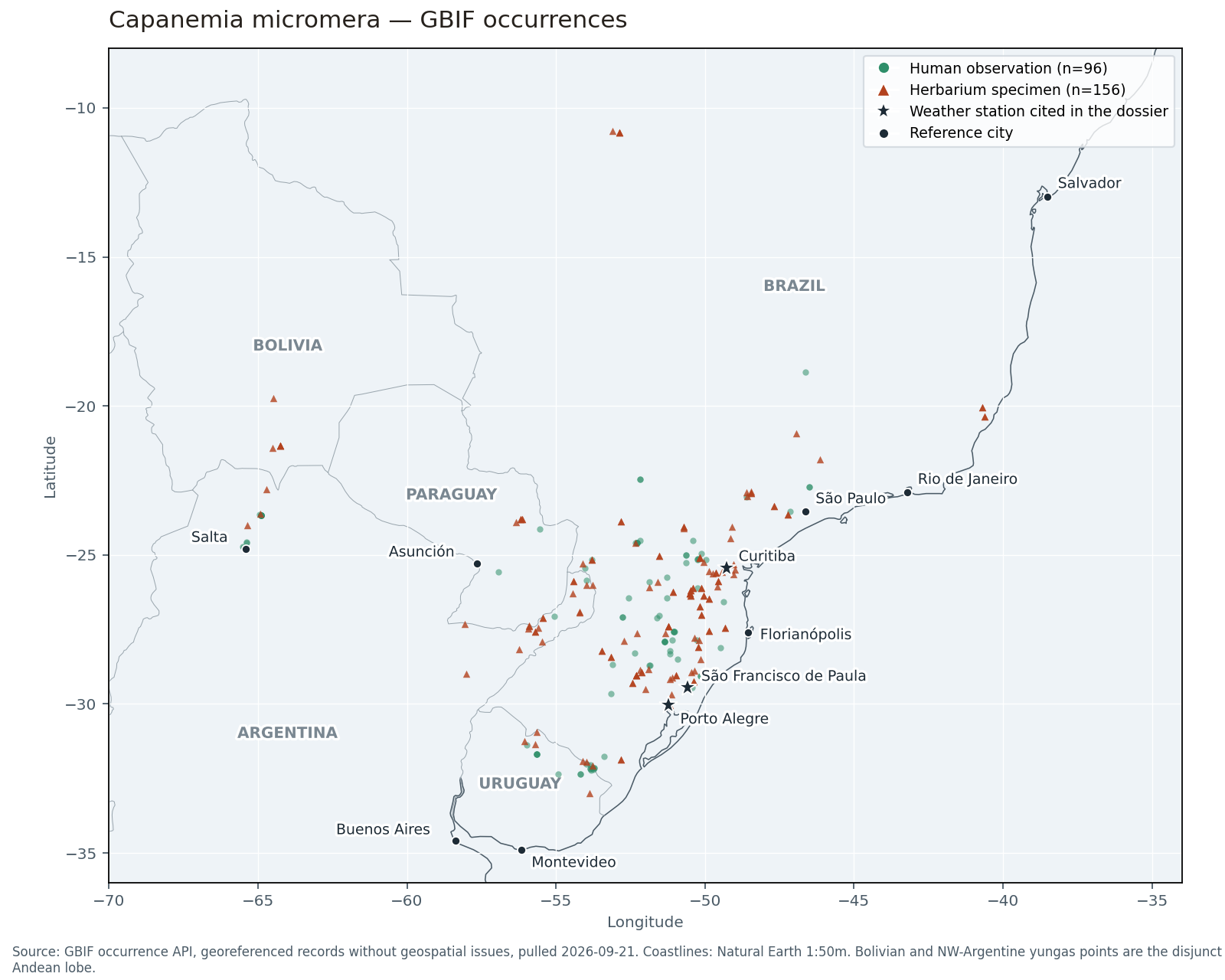 Distribution map — 252 georeferenced GBIF records (Brazil, Argentina, Uruguay, Paraguay, Bolivia). Triangles = herbarium specimens; dots = human observations (iNaturalist etc.). Drawn 2026-09-21 from the GBIF occurrence API over Natural Earth coastlines.
Countries: Brazil, Argentina, Uruguay, Paraguay, Bolivia [P: GBIF occurrence facets; Flora e Funga do Brasil; Marín Pérez et al. 2020] [2] [3] [10]. POWO’s summary phrase is “SE. & S. Brazil to Bolivia and N. Argentina” [S] [1]. IOSPE and several nurseries add Venezuela; no database or herbarium record supports Venezuela and I treat it as an error [U] [11].
Brazilian states per Flora e Funga do Brasil: Bahia, Espírito Santo, Minas Gerais, Rio de Janeiro, São Paulo, Paraná, Santa Catarina, Rio Grande do Sul. Phytogeographic domains: Mata Atlântica and Pampa [P] [3]. The Bahia record (Vitória da Conquista, 14°59’S, 40°48’W, 821 m) set the northern limit of the genus in 2011 [P] [8].
Argentina: Corrientes, Misiones, Salta, Jujuy [P: GBIF] [2]; Uruguay: Cerro Largo, Rivera, Rocha, Tacuarembó, Treinta y Tres [P] [10] [12]; Paraguay: San Pedro, Canindeyú, Paraguarí, Guairá, Cordillera, Alto Paraguay [P: GBIF] [2]; Bolivia: Tarija, Chuquisaca [P: GBIF/Tropicos records] [2].
GBIF occurrence summary (queried 2026-09-21) [P] [2]
| Measure | Value |
|---|---|
| Total records | 744 |
| Preserved specimens / human observations | 640 / 102 |
| Georeferenced | 303 |
| Brazil / Argentina / Uruguay / Paraguay / Bolivia | 619 / 56 / 26 / 25 / 6 |
| Top states | Paraná 212, Rio Grande do Sul 200, Santa Catarina 87, São Paulo 37, Misiones 23, Cerro Largo 15, Jujuy 14, Minas Gerais 14 |
| Southernmost georeferenced point | 32.99°S, Treinta y Tres, Uruguay |
| Northernmost credible point | Bahia, ca. 15°S (one 10.8°S Brazilian point and one Goiás record look like errors) |
The centre of density is the Paraná–Santa Catarina–Rio Grande do Sul plateau and its Araucaria forests, with the Uruguayan and Misiones records forming the southern and western lobes and the Andean yungas a disjunct high-elevation lobe.
Elevation
| Source | Range or figure | Confidence |
|---|---|---|
| CNCFlora red-list assessment 2012 | 10 m (coast) to 1,389 m (Bom Jardim da Serra, SC); also 1,052 m Cambará do Sul RS, 1,110 m Inácio Martins PR | [P] [7] |
| Buzatto & Machado 2011 | “humid forests from about sea level to between 850 and 1100 m”; Bahia record at 821 m | [P] [8] |
| Buzatto et al. 2012, for the genus | “almost exclusively in the Atlantic Rain Forest domain between 450 and 1400 m a.s.l.” | [P] [6] |
| GBIF, 76 georeferenced records with elevation (of 300 sampled) | 0–2,092 m; Brazilian records 390–1,163 m; median 739 m (23 records show 0 m and may be placeholders) | [P] [2] |
| Bolivian outliers | 1,600 m (Tarija, Rancho Huayco, forest logged for Podocarpus and Juglans, 1987) and 2,092 m (Chuquisaca, secondary forest, 2007) | [P] [2] |
| Argentine yungas | 1,348 m (Salta/Jujuy, 2021) | [P] [2] |
| Orquídeas Gaúchas (regional site) | sea level to over 900 m in Rio Grande do Sul | [S] [13] |
Biomes and vegetation types. Flora e Funga do Brasil lists gallery/riparian forest, seasonal semideciduous forest, ombrophilous (rain) forest, and Floresta Ombrófila Mista (mixed ombrophilous forest, the Araucaria forest) [P] [3]. CNCFlora adds seasonal deciduous forest [P] [7]. Herbarium labels confirm Araucaria forest (“mata com araucária”), alluvial Araucaria forest, Atlantic rain forest (Floresta Ombrófila Densa), and the Araucaria–seasonal-forest ecotone [P] [2]. In Uruguay it occupies hill forests (bosques serranos), palm groves (palmares) and riverside forests across three eco-regions [P] [10] [12]. It does not appear in Cerrado or open Pampa grassland; the Pampa domain listing refers to forest patches within that domain [P] [3].
3. Habitat and microhabitat
Life form: holoepiphyte, never recorded as a lithophyte in the sources consulted [P] [3] [7]. CNCFlora: “Planta epífita, 7-59 mm alt., ocorrendo principalmente entre líquens e musgos em matas ciliares,” found also in forest interior “generally under high relative humidity” [P] [7]. The Portuguese Wikipedia summary of the 2010 regional revision says it occurs both in shaded forest interior and on outer branches exposed to sun [S] [14].
Substrate: thin branches. The Argentine hobby-society page summarising Flora Argentina says it grows “sobre las ramas menores de árboles” under varied exposure [S] [15]. Herbarium labels (GBIF) give direct evidence [P] [2]:
| Year, place | Label text (translated) | Reading |
|---|---|---|
| 2026, Paraná | epiphytic herb, semi-shade, riparian; phorophyte Endlicheria paniculata (Lauraceae) | native forest tree |
| 2026, Rio Grande do Sul | “em galhos finos de Myrtaceae” (on thin Myrtaceae twigs) | twig epiphyte |
| 2009, São Paulo | micro-orchid on a branch of a Eugenia (Myrtaceae), near a watercourse | twig, riparian |
| 2009, Paraná | epiphytic herb, heliophytic; phorophyte Ilex paraguariensis (yerba mate) | full sun, cultivated tree |
| 2009, Santa Catarina | epiphyte on a fallen trunk, below 4 m, advanced-stage rain forest | low stratum |
| 2000, Rio Grande do Sul | collected on trunks in forest interior | trunk, not only twigs |
| 1909, Paraná (Dusén) | “in tr. arb. cult.” (on trunks of cultivated trees) | anthropic habitat |
| 2019, Porto Alegre Botanical Garden | wild-established on a Bignoniaceae collection tree | urban, cultivated tree |
| 1957, Farroupilha RS | Estação Experimental de Fruticultura (fruit-growing station) | orchard trees |
Light: the labels use all three Brazilian light classes for this one species: ciófila (shade), semi-ciófila, and heliófita (sun) [P] [2]. This is unusual and consistent with a twig-epiphyte strategy that colonises whatever thin branches are available.
Disturbed and cultivated habitats: CNCFlora states it “occurs in areas of great anthropic interference,” with 14 of 24 sampled individuals in Paraná in degraded areas, and 200 individuals rescued and reintroduced during the Salto Forqueta hydro-plant works [P] [7]. Labels record it on roadside verges (“margem da rodovia, área antropizada”), in medium-regeneration secondary forest, and in Bolivia in heavily logged and secondary forest [P] [2]. An Iguazú flora (Johnson 2001, quoted on an iNaturalist record) calls it a pioneer species “que suele ser encontrada creciendo sobre especies arbóreas exóticas, como ser el naranjo” (orange trees) [S] [2].
Associated cryptogams: mosses and lichens on the branch surface, per CNCFlora and the Brazilian grower literature (“finos ramos de árvores cobertos de musgo”) [P] [7] [S] [16].
Twig-epiphyte status. Chase (1987) defined obligate twig epiphytes as those “that occur predominantly on less than 2-year-old ultimate branchlets and twigs,” and Gravendeel et al. 2004 tie the syndrome to small body size, short life cycle and clinging roots in Oncidiinae [P] [17]. Capanemia is not named in that paper. The label data above and the Flora Argentina description place C. micromera in this syndrome functionally, but I found no paper that formally classifies it as an obligate twig epiphyte [U].
4. Climate at the native sites
Three stations bracket the core range. All tables are Wikipedia transcriptions of Instituto Nacional de Meteorologia (INMET, Brazil’s national meteorological institute) normals [S]. Curitiba sits at about 924 m in the Araucaria plateau where Paraná’s 200-plus records concentrate; Porto Alegre (10 m) represents the low-elevation Rio Grande do Sul and Uruguayan lobe; São Francisco de Paula (907 m) is the wet Araucaria highland of north-east Rio Grande do Sul where the 2011 Boelter et al. epiphyte survey sampled 13 individuals [7].
Curitiba, Paraná (Köppen Cfb), INMET 1991–2020 [S] [18]
| Month | Mean max °C | Mean °C | Mean min °C | Record low °C | Rain mm | Rain days | RH % | Sun h |
|---|---|---|---|---|---|---|---|---|
| Jan | 27.1 | 21.3 | 17.6 | 8.2 | 226 | 15 | 81 | 162 |
| Feb | 27.2 | 21.4 | 17.8 | 6.8 | 189 | 13 | 81 | 150 |
| Mar | 26.1 | 20.3 | 16.8 | 3.9 | 151 | 12 | 82 | 159 |
| Apr | 24.4 | 18.5 | 14.8 | −4.0 | 88 | 7 | 81 | 161 |
| May | 21.1 | 15.5 | 11.8 | −2.3 | 96 | 8 | 83 | 147 |
| Jun | 20.3 | 14.3 | 10.3 | −4.4 | 112 | 7 | 82 | 141 |
| Jul | 20.1 | 13.8 | 9.3 | −5.2 | 106 | 7 | 80 | 166 |
| Aug | 21.9 | 14.9 | 10.1 | −5.2 | 82 | 6 | 77 | 180 |
| Sep | 22.3 | 16.0 | 11.9 | −5.4 | 143 | 9 | 80 | 136 |
| Oct | 23.7 | 17.7 | 13.9 | −1.5 | 161 | 11 | 81 | 136 |
| Nov | 25.0 | 18.9 | 15.0 | −0.9 | 126 | 10 | 79 | 159 |
| Dec | 26.7 | 20.7 | 16.7 | 3.6 | 152 | 12 | 79 | 165 |
| Year | 23.8 | 17.8 | 13.8 | −5.4 | 1,631 | 117 | 81 | 1,862 |
Porto Alegre, Rio Grande do Sul (Köppen Cfa), INMET 1991–2020 [S] [19]
| Month | Mean max °C | Mean °C | Mean min °C | Rain mm | Rain days | RH % | Sun h |
|---|---|---|---|---|---|---|---|
| Jan | 31.0 | 25.0 | 20.7 | 121 | 9 | 73 | 238 |
| Feb | 30.5 | 24.7 | 20.7 | 111 | 9 | 75 | 207 |
| Mar | 29.2 | 23.5 | 19.5 | 103 | 9 | 76 | 207 |
| Apr | 26.4 | 20.7 | 16.8 | 114 | 9 | 78 | 167 |
| May | 22.6 | 17.2 | 13.5 | 113 | 8 | 82 | 144 |
| Jun | 20.3 | 14.8 | 11.3 | 130 | 9 | 83 | 119 |
| Jul | 19.7 | 14.1 | 10.4 | 164 | 9 | 81 | 134 |
| Aug | 21.8 | 15.7 | 11.6 | 120 | 9 | 78 | 150 |
| Sep | 22.8 | 17.2 | 13.3 | 148 | 10 | 77 | 150 |
| Oct | 25.2 | 19.7 | 15.7 | 153 | 10 | 76 | 176 |
| Nov | 27.7 | 21.7 | 17.2 | 106 | 8 | 72 | 224 |
| Dec | 30.0 | 24.0 | 19.4 | 116 | 9 | 71 | 239 |
| Year | 25.6 | 19.9 | 15.8 | 1,498 | 106 | 77 | 2,153 |
São Francisco de Paula, Rio Grande do Sul (Köppen Cfb, 907 m), 1961–2014 [S] [20]
| Month | Mean max °C | Mean °C | Mean min °C | Rain mm |
|---|---|---|---|---|
| Jan | 24.9 | 19.8 | 14.8 | 187 |
| Feb | 24.2 | 19.4 | 14.7 | 182 |
| Mar | 23.0 | 18.2 | 13.5 | 182 |
| Apr | 19.9 | 15.2 | 10.5 | 169 |
| May | 17.6 | 12.9 | 8.3 | 165 |
| Jun | 16.3 | 11.7 | 7.1 | 191 |
| Jul | 16.3 | 11.3 | 6.4 | 170 |
| Aug | 17.3 | 12.3 | 7.4 | 170 |
| Sep | 18.1 | 13.4 | 8.7 | 201 |
| Oct | 20.0 | 15.0 | 10.1 | 188 |
| Nov | 22.0 | 16.8 | 11.6 | 139 |
| Dec | 23.3 | 18.0 | 12.7 | 166 |
| Year | 20.2 | 15.3 | 10.5 | 2,110 |
What the tables say together. There is no true dry season anywhere in the core range; rain falls in every month, with a modest winter minimum on the Paraná plateau (April–August 82–112 mm at Curitiba) and none at all in the Rio Grande do Sul highlands. Winter nights run 6–12 °C at the plateau stations with frost every year (Curitiba record lows below −5 °C in June–September); summer days reach 24–31 °C. Relative humidity stays near 77–83 % year-round, highest in late autumn and winter. August is the sunniest and driest month at Curitiba, which coincides with the flowering peak (section 5).
The Bolivian and Salta–Jujuy yungas records at 1,350–2,100 m sit in a different regime (montane cloud forest with a marked dry winter). No station table was compiled for that lobe; it is a minority of records and I could not confirm whether the plants there are the same lineage [U].
5. Phenology
Wild flowering peaks in late austral winter and early spring, July through September, with a tail into December in the south.
| Evidence | Months | Confidence |
|---|---|---|
| GBIF collection month, all 744 records (638 dated) | Sep 149, Aug 131, Jul 113, Jun 73, May 41, Dec 26, Oct 25, Apr 23, Nov 20, Feb 18, Jan 11, Mar 8. Jul–Sep = 62 % of dated records | [P] [2] |
| iNaturalist research-grade observations annotated “flowering” (n = 14) | Jun 1, Jul 4, Aug 4, Sep 4, Oct 1 | [P] [21] |
| iNaturalist all research-grade observations (n = 112) by month | Aug 21, Jul 15, Sep 14, Dec 13, Jun 12, May 11 | [P] [21] |
| Buzatto & Machado 2011, Bahia | “In Bahia state the flowering period is in the month of August” | [P] [8] |
| Izaguirre 1972, Uruguay | “Florece de setiembre a diciembre y cultivada en invernáculo, desde julio” | [P] [9] |
| Argentine hobby society (Flora Argentina summary) | May to September | [S] [15] |
| Iguazú flora (Johnson 2001, quoted on a Paraná record) | July to August | [S] [2] |
| Brazilian grower blog (São Paulo region) | “Floresce normalmente no inverno” | [S] [16] |
| Orquídeas Gaúchas photo dates | July–August | [S] [13] |
| IOSPE | “spring and summer” | [S] [11] |
| Orquidário Aparecida (nursery) | “Floração: Verão” | [S] [22] |
Herbarium labels add detail: buds “iniciando ântese” in August (Paraná 2019), open flowers in every August and September label, and “fruto imaturo” (immature fruit) in October 2022 in Santa Catarina [P] [2]. A flowering-date field on one São Paulo specimen reads 5 May 2004 [P] [2]. The two summer statements (IOSPE, Aparecida) are outnumbered and unsupported by specimen data; I read them as errors or as greenhouse observations.
Collection month is a proxy: botanists collect this species when it is visible, which is when it flowers, so the histogram is a flowering histogram with a bias toward field-season access. The iNaturalist flowering annotations are independent and agree.
Trigger: no experimental or observational paper tests a cue. The peak coincides with the coldest nights (9–12 °C at Curitiba), the driest and sunniest month (August), and lengthening days after the June solstice [S: inference from the climate tables above]. Izaguirre’s greenhouse plants flowered from July, two months ahead of the wild September onset, which suggests warmth advances bud development once initiation has occurred [P, single observation] [9].
Flower longevity: about 30 days per blooming cycle, per one Brazilian grower blog [S] [16]. No primary source measured individual flower lifespan [U].
New growth and root initiation: no source gives timing [U]. Izaguirre notes that some upper flowers on a raceme never open [P] [9].
6. Reproductive biology
Flower morphology (Izaguirre 1972, fresh Uruguayan material; Buzatto et al. 2012) [P] [9] [6]:
| Character | Value |
|---|---|
| Inflorescence | basal, from the axil of the leaf-bracts, filiform scape, simple raceme, 2–4 flowers (1–5 in Argentine summary; “1 to 2, simple or branched, 1.5 cm” in IOSPE) |
| Flower size | ca. 5 mm total length (Izaguirre); “up to 12 mm” (Buzatto & Machado, likely including ovary) |
| Colour | pure white, sometimes faintly reddish at the base of sepals and petals; yellow only on the lip callus; a yellow spot between the labellar calli; some Rio Grande do Sul plants with pink dots on the lip |
| Dorsal sepal | oblong-spathulate, 3.5 × 1 mm, apiculate, recurved |
| Lateral sepals | lanceolate-oblong, 3–4 mm, partly fused 0.4–0.5 mm at the base forming a tiny chin |
| Petals | oblong, 3–3.5 mm |
| Labellum | 3.5–5.5 mm, long-pandurate (fiddle-shaped), oblong-lanceolate with acuminate downcurved apex, papillose with unicellular trichomes, callus at the base with strong yellow pigment |
| Column | short, 0.5–0.6 mm, glabrous, with two large horizontal auricles 1.2–1.5 mm “like two arms extended toward the lip”; wings partly conceal the stigmatic cavity |
| Anther | dorsal, unilocular, rostrate |
| Pollinarium | two subspherical pollinia 0.25 mm diameter, white laminar stipe 0.9–1 mm, oval red-brown viscidium 0.3 mm; mean pollinarium 1.33 × 0.59 mm, clavate to reniform pollinia on a proportionally long tegular stipe |
| Reward | none. “absence of nectar or any other secretion that might function as a food-reward” |
| Scent | fragrant (Buzatto et al. 2012; “muy perfumadas” in Argentina; “cheiro de cravo adocicado,” sweet clove, on a São Paulo iNaturalist record) |
Osmophores: Buzatto et al. 2012 judged it unlikely that the lip papillae function primarily as osmophores in this genus [P] [6].
Pollinators. Buzatto et al. 2012: “The small halictid bee Dialictus (Chloralictus) nanus is known to visit the fragrant flowers of C. micromera, whereas a larger, unidentified species of halictid bee has also been observed hovering in front of flowers of that same species.” Pollinarium removal by insects was observed in the genus, but deposition on the stigma was not [P] [6]. Flora e Funga do Brasil cites Singer and Cocucci 1999 (Lindleyana 14: 47–56) as the underlying observation [P] [3]; I could not fetch that paper [U for its details]. The sweat bee is a nectar- and pollen-forager, so visits to a nectarless, fragrant white flower point to food deception.
Pansarin 2021 (Plant Biology 23: 259–266) surveyed 32 miniature Oncidiinae and found that “two species of Capanemia (6.25 %) do not offer any floral reward, suggesting that pollination by food deception is involved” [P] [23]. Which two species was not visible in the abstract [U whether C. micromera is one]. By contrast, C. thereziae has a shallow nectary and is pollinated by Polybia wasps [P] [6] [24].
Breeding system: no self-compatibility test for C. micromera was found [U]. Across Oncidiinae, 69.4 % of studied species are self-incompatible and fruiting success is “generally low” [P] [24].
Fruit set and seed: Izaguirre saw “frutos y semillas no vistos” and every Uruguayan specimen “siempre sin fruto” [P] [9]. Immature fruits were recorded in Santa Catarina in October 2022 [P] [2], so wild fruit set occurs but appears infrequent. Seed description: none found [U]. A nursery notes seedlings can bloom while still in flask [S] [25], consistent with the short twig-epiphyte life cycle.
7. Growth habit and morphology
From Izaguirre 1972 (fresh material) [P] [9], Buzatto & Machado 2011 [P] [8], CNCFlora [P] [7], and regional summaries [S] [13] [15]:
| Organ | Description |
|---|---|
| Whole plant | 7–59 mm tall (CNCFlora); 1–9.5 cm (Buzatto & Machado); forms semicircular mats up to 15 cm across (Argentine summary) |
| Rhizome | very short, so pseudobulbs sit in tight clusters (“crescendo em touceiras”) |
| Pseudobulbs | ovoid to elongate, 3–4 mm wide × 6–10 mm long (Izaguirre); 3–8 mm (Orquídeas Gaúchas); light green, slightly rugose, one-leaved, sheathed at the base by papery brown scales 3–10 mm long |
| Leaves | fleshy, subterete, rush-like (junciform), subcircular in section with a ventral groove almost to the tip, 1.5–4 cm × 0.9–1 mm, very acute, upper half sometimes recurved; grey-green (IOSPE). Two kinds: one apical on the pseudobulb, two lateral “leaf-bracts” at its base |
| Roots | long, flexuous, glabrous; multiseriate velamen; strongly thickened endodermis; abundant endomycorrhiza; spread several centimetres beyond the clump; up to 10 cm (Iguazú flora, quoted) |
| Anatomy | raphide idioblasts throughout the plant |
Spread is by lateral pseudobulb production on the short rhizome, giving a mat; no stolons or keikis are described [P] [9]. Lifespan and generation time are not reported anywhere I found [U]. The twig-epiphyte literature predicts a short life cycle and fast maturation for plants of this habit [P for the syndrome, U for this species] [17].
8. Conservation status and threats
| Authority | Status | Confidence |
|---|---|---|
| CNCFlora (Centro Nacional de Conservação da Flora, Brazil), 2012 assessment | LC (Least Concern). Extent of occurrence 693,994 km²; area of occupancy 276 km²; “occurs in areas of great anthropic interference, is well represented in protected areas,” wide distribution | [P] [7] |
| Uruguay, Marín Pérez, Pessoa & Alves 2020, Lankesteriana 20(3): 359–394 | “Prioritaria (Criterio 3, 4)” (national priority species for conservation) | [P] [10] |
| Uruguay epiphyte catalogue 2019, Acta Botanica Brasilica 33(4) | LC; “underestimated for a long time, due to the small size of the plants” | [P] [12] |
| IUCN (International Union for Conservation of Nature) global Red List | no assessment found by site search | [U, negative] |
| Argentina, SIB (Sistema de Información de Biodiversidad) | present in 4 national protected areas | [P] [26] |
| CITES (Convention on International Trade in Endangered Species) | Appendix II, as all Orchidaceae; seeds, flasked seedlings and cut flowers of artificially propagated plants exempt | [S: cites.org pages returned 403; confirmed by search excerpts of CITES and US regulations] [27] |
Threats named by CNCFlora: habitat loss and degradation; 14 of 24 sampled Paraná individuals in degraded areas; a rescue-and-reintroduction of 200 plants at Salto Forqueta [P] [7]. Several GBIF records are themselves flora-rescue collections ahead of hydro-plant reservoirs and power lines in Paraná [P] [2]. Its tolerance of orchards, roadsides and secondary forest offsets this at the population level.
9. Cultivation notes that cite in situ conditions
Only statements tied to the wild conditions are kept here.
IOSPE: “shaded forests along the edge of arroyos”; cool to warm, deep shade [S] [11]. This matches the riparian, semi-shade labels but ignores the heliophytic records.
Argentine society: “Lo ideal es cultivarla en ramitas delgadas o pequeños troncos” (thin twigs or small sticks), because it grows on minor branches under varied exposure [S] [15].
Brazilian grower (São Paulo region): mount on small branches with roots exposed; 60–70 % shade; tolerates 0–35 °C; “prefers cool nights”; flowering lasts about 30 days; blooms in winter [S] [16]. The 0 °C floor is consistent with the Curitiba record lows.
Orquidário Aparecida (São Paulo nursery): 70–80 % shade cloth [S] [22]. Seattle Orchid: warm to hot, full shade, dry between waterings [S] [28]; the “hot” contradicts the plateau climate and I would discount it.
Izaguirre 1972: greenhouse plants in Montevideo flowered from July, two months before wild plants [P] [9].
10. What this means for reading the cultivated plant
Calendar. Wild plants flower July–September, the tail of austral winter. The Madison plant spiked on 20 September 2026, the northern autumn equinox. The two share the same calendar month with opposite seasons, so the plant is either (a) still running on a southern-hemisphere internal calendar that survived import and terrarium conditions, or (b) responding to nothing seasonal at all, since a climate-controlled terrarium removes the cues. The sources cannot separate these; a second year of dates will.
What the wild plant is experiencing at flowering (Curitiba plateau, August–September): mean day 22 °C, mean night 10–12 °C, nights occasionally to −5 °C, the driest month of the year (82 mm) followed by rising rain, relative humidity 77–80 %, and the sunniest month (180 h) on lengthening days [S] [18]. At Porto Alegre elevation the same months run 22–23 °C day / 12–13 °C night with no rainfall dip [S] [19]. In short: cool, bright, humid but not sodden, day-night swing of about 10 °C.
The night-temperature contrast is the single largest gap between a terrarium and the native site. A 10 °C day-night swing and winter nights near 10 °C are the norm across the range; a terrarium that holds 20 °C-plus at night is warmer at night than any station in the core range in any month except December–February at Porto Alegre.
Flower reading. Expect 1–5 white 5-mm flowers per raceme, sometimes with unopened upper buds, a yellow callus, fragrance (clove-sweet on at least one record), and roughly a month of display. No nectar; nothing to pollinate it indoors, and self-compatibility is unknown, so no capsule is expected. Immature capsules appear in the wild about six weeks after peak flowering.
Light. Wild plants span deep shade to full sun on yerba-mate branches, so a plant flowering in terrarium light is within range; the labels suggest more light is tolerated than the “deep shade” cultivation advice implies.
Growth. New pseudobulbs stay clustered on a very short rhizome and the mat spreads by a few millimetres per bulb. Roots reach several centimetres beyond the clump on the wild twig, and the velamen and mycorrhiza in Izaguirre’s anatomy suggest roots that need air and periodic drying rather than constant saturation, a trait shared across twig epiphytes.
Study notes (his questions, 2026-09-21, answered for learning — one-sentence answer · the system · mechanism · discriminator · home · hook)
Is “mini-miniature” an official category? No; grower jargon. System: hobby usage, not American Orchid Society judging, which has no size classes; “miniature” ≈ under 15 cm, “mini-miniature” the step below. Mechanism: the phrase exists because Oncidiinae twig epiphytes cluster at a body size most growers never meet. Discriminator: miniature is a plant you can pot; mini-miniature is a plant you mount on a twig. Home: the whole plant is 7–59 mm (CNCFlora). Hook: what is the AOS’s actual unit for judging size? (There isn’t one.)
Is “subtropical Atlantic Forest” a designation? Half. System: the Atlantic Forest (Mata Atlântica) is an official IBGE biome with its own federal law (2006); “subtropical” is a climatic qualifier for the part south of the Tropic of Capricorn (Köppen Cfa/Cfb), a biogeographer’s word not a legal one. Mechanism: latitude + the plateau bring frost and no dry season. Discriminator: biome (legal/IBGE) vs. climatic zone (descriptive). Home: the plant’s density centre is the subtropical third. Hook: which IBGE vegetation type is the Araucaria forest?
In what way riparian? Gallery forest along watercourses. System: IBGE “formação ripária / mata ciliar”; in the dossier it comes from Flora e Funga do Brasil and herbarium labels (“near a watercourse”). Mechanism: the river strip stays humid through the seasonal winter and cuts a bright edge through the canopy — humidity plus light at once. Discriminator: riparian = defined by the water’s edge; gallery = the same strip where it is the only forest in a grassland. Home: the box’s mist gives the humidity; the bright tier gives the edge. Hook: why would a twig epiphyte prefer an edge to an interior?
What is an Araucaria forest? IBGE’s Floresta Ombrófila Mista, mixed rain forest of the southern plateau (~500–1,500 m). System: IBGE vegetation classification (Veloso et al.). Mechanism: cool, foggy, frost-prone, no dry season; emergent Araucaria angustifolia over Lauraceae, Myrtaceae, Podocarpus, yerba mate. Discriminator: “Mista” (conifer + broadleaf) vs. “Densa” (broadleaf lowland-to-montane rain forest). Home: Curitiba and São Francisco de Paula are Araucaria-plateau stations — the climate tables in §4. Hook: how much of the original Araucaria forest survives? (~3 %.)
The bee visitors. Dialictus (Chloralictus) nanus, a tiny halictid sweat bee (subgenus Dialictus of Lasioglossum), generalist nectar/pollen forager. System: Buzatto et al. 2012 (Annals of Botany), originally Singer & Cocucci 1999. Mechanism: the flower is nectarless and its lip papillae are probably not scent glands → food deception (Pansarin 2021: two Capanemia rewardless). Discriminator: visitation ≠ pollination — pollinaria were seen removed, never deposited. Home: no pollinator in the box, no capsule expected. Hook: what would you need to observe to prove pollination rather than visitation?
How Kew’s naming system works. Three linked databases: IPNI (nomenclature: every validly published name, author, place, date — no opinion), WCVP (taxonomy: Kew editors’ accepted-vs-synonym decisions under the International Code of Nomenclature), POWO (the public face joining both + distribution by TDWG regions). Discriminator: a name can be valid (IPNI) and still not accepted (WCVP). Home: “accepted per POWO” = Kew’s current editorial opinion; GBIF’s backbone can lag or differ. Hook: which of the three would you check to learn who published a name and when?
What is GBIF? The Global Biodiversity Information Facility: an intergovernmental index (Copenhagen) aggregating occurrence records from herbaria, museums, surveys, iNaturalist, with an open API. Mechanism: each record keeps source, coordinates, date, basis-of-record. Discriminator: GBIF is an aggregator of occurrences, not an authority on names (it borrows a backbone). Home: the map = 252 GBIF records; triangles are specimens, dots are observations; density follows recorders. Hook: why does the Hoya map need a native-range clip and the Capanemia map not?
Molecular placement. Orchidaceae › Epidendroideae › Cymbidieae › Oncidiinae; within Oncidiinae, Capanemia sister to Sanderella (Buzatto et al. 2020, low support); Pabst’s leaf-shape sections rejected by the DNA. Discriminator: placement is firm at subtribe, soft at sister-genus. Home: “Oncidiinae twig epiphyte” is the functional label that predicts its care. Hook: what does “low support” mean on a phylogeny, and why keep the result anyway?
“Secondary forest” here. Regrowth after clearing or logging, vs. primary (never cut). System: land-cover class on herbarium labels (“média regeneração”, “área antropizada”). Mechanism: young regrowth = many thin, sunlit branches — the twig-epiphyte perch. Discriminator: secondary (regrown) vs. degraded primary (thinned but never cleared). Home: disturbance tolerance is why it is Least Concern and why it colonizes orchard and yerba-mate trees. Hook: what other trait in the syndrome fits a colonizer?
Semideciduous and ombrophilous. IBGE forest types: Ombrophilous (“rain-loving”) = evergreen, high rainfall, no dry season (Densa = broadleaf; Mista = with Araucaria); Estacional Semidecidual = seasonal forest where 20–50 % of canopy trees drop leaves in the dry/cold months. Discriminator: the deciding statistic is the share of the canopy that goes bare. Home: recorded in all of them → the plant is choosy about the twig, not the forest. Hook: which type is Curitiba’s forest?
What is a holoepiphyte? A plant that lives its whole cycle on another plant, never rooting in soil. System: epiphyte life-form classes (Benzing). Discriminator: hemiepiphyte (starts or ends in soil) · accidental epiphyte (can go either way) · lithophyte (on rock). Home: never recorded on rock or ground — the mount is its life. Hook: is a strangler fig a holo- or hemi-epiphyte?
Obligate twig epiphyte, and mounting. Chase 1987: found predominantly on ultimate branchlets < 2 years old; a life-history syndrome (tiny body, early flowering, short life, clasping roots, tolerance of high light and fast drying). System: Chase 1987 / Gravendeel et al. 2004; the dossier found no paper formally assigning C. micromera — functionally it fits. Discriminator: twig epiphyte vs. trunk epiphyte = perch diameter and age. Home, four rules: mount on a thin twig, not a slab, so roots wrap; roots in air, no moss over them; more light than the shaded tiers (full-sun yerba mate is in the record); don’t expect permanence — a colonizer that flowers young is behaving normally when its mount fails in a few years. Living moss beside it is fine; over the crown it is not. Hook: what does the two-year-old-twig rule imply about how long a wild individual lives?
What is phenology here? The timing of recurring life events — flowering, fruiting, new growth, roots — and how they track the seasons. System: a branch of ecology; in this dossier a data category read from the month field on herbarium specimens and iNaturalist “flowering” annotations. Mechanism: events run on cues (day length, temperature, dry-to-wet, drought-release); here the likely cue is the cool bright winter. Discriminator: phenology = when; physiology = how (cues, hormones); ecology = where and with whom. Home: wild peak Jul–Sep under 10–12 °C nights; the box spiked the same calendar month, opposite season, no cool nights — a residual southern clock or no clock, and only the next spike’s date can tell. Hook: when it spikes next, before looking anything up, ask what month it is in Curitiba.
Any documented mutualism between tree and epiphyte? Yes, at the mat scale, not the single orchid. System: symbiosis categories (mutualism / commensalism / parasitism); epiphytes are commensal by definition. Mechanism: (1) canopy roots — hosts send adventitious roots from their branches into the moss-humus-epiphyte mat and feed from it (Nadkarni, Science 214, 1981 — from Monteverde); (2) nitrogen fixation by cyanobacteria living on epiphytic bryophytes and lichens reaches the tree by leaching and canopy roots; (3) water/microclimate buffering by tank bromeliads and thick moss. Reverse case: Benzing’s nutrient piracy — epiphytes intercept mist/throughfall nutrients first; heavy loads add weight and shade. Discriminator: a twig orchid gives its twig nothing; the mutualism is emergent where a mat has formed and the tree roots into it — trunk story, not twig story. Home: the volunteer moss on the Capanemia’s plank is a mat beginning; fine beside the plant, not over the crown. Hook: what would you look for on a Monteverde branch to tell whether the tree was rooting into its own epiphytes?
Group 9 — status and trade, and the cultivation words (lesson closed 2026-09-22). A status is a verdict from a named assessor, and “no verdict” is not “safe.” System: IUCN (International Union for Conservation of Nature) Red List categories — LC · NT · VU · EN · CR · NE = Not Evaluated; national lists (CNCFlora, Centro Nacional de Conservação da Flora, Brazil) use the same scale independently; CITES (Convention on International Trade in Endangered Species, /ˈsaɪtiːz/ SY-teez) Appendix II = trade by permit, Appendix I = trade banned, artificially propagated Appendix I plants traded as if II. Mechanism: criterion B measures EOO (extent of occurrence, the polygon round all records) against AOO (area of occupancy, the 2 × 2 km cells actually holding a record) — Capanemia: EOO 693,994 km² vs AOO 276 km², about the area of the city of Madison, and still LC because the AOO is a sampling shadow of a plant too small to be collected, not a measure of how much habitat it occupies. Discriminator: NE ≠ LC (the Specklinia and the hoya have no verdict at all); Appendix II regulates, it does not ban; a cultivar (/ˈkʌltɪvɑːr/, ICNCP = International Code of Nomenclature for Cultivated Plants, single quotes) is a horticultural label, not a botanical rank; a sport is a spontaneous mutant shoot propagated on (‘Compacta’, Hummel 1967); variegation by chimera (/kaɪˈmɪərə/ ky-MEER-uh, two genetically different cell layers in one plant, ‘Krimson Queen’) changes the leaf and leaves the species’ flowers untouched. Home: the box holds one Appendix I genus, Paphiopedilum (the Ho Chi Minh, an artificially propagated hybrid of two Vietnamese species); the Specklinia carries an iNaturalist “Sensitive” geoprivacy flag, no assessment, and a commercial listing at Ecuagenera — three signals, none of them a status; the heirloom hoya’s plain green leaf says “no named sport,” and its flowers will read as the species either way. Hook: Least Concern with an AOO the size of Madison — what would have to be true of the sampling for that verdict to be wrong?
Sources
- https://powo.science.kew.org/taxon/urn:lsid:ipni.org:names:621744-1 — Kew POWO: accepted name, type species, 1877 protologue, range summary (search excerpt; direct fetch blocked).
- https://www.gbif.org/species/2847948 and https://api.gbif.org/v1/occurrence/search?taxonKey=2847948 — GBIF backbone synonyms; 744 occurrence records; country, state, month and elevation facets; herbarium label text (phorophytes, light class, forest type, flowering, immature fruit).
- https://servicos.jbrj.gov.br/v2/flora/taxon/Capanemia%20micromera — Flora e Funga do Brasil API: accepted status, eight states, domains, vegetation types, synonyms, references (Buzatto et al. 2010; Singer & Cocucci 1999).
- https://en.wikipedia.org/wiki/Capanemia — subtribe placement; outdated nine-species list.
- https://link.springer.com/article/10.1007/s00606-020-01632-4 — Buzatto et al. 2020, Plant Syst. Evol. 306: 25; six species, five synonyms, sections rejected, Sanderella sister.
- https://pmc.ncbi.nlm.nih.gov/articles/PMC3241572/ — Buzatto et al. 2012, Annals of Botany 109: 135; genus 450–1400 m, seven species, floral characters, pollinarium 1.33 × 0.59 mm, no nectar, Dialictus nanus visits, pollinaria removed but not deposited.
- https://proflora.jbrj.gov.br/html/Capanemia%20micromera_2012.html — CNCFlora 2012: LC, EOO/AOO, 10–1,389 m, 7–59 mm plant, lichens and mosses in riparian forest, threats, rescue of 200 plants.
- https://doi.org/10.1590/s0102-33062011000100029 — Buzatto & Machado 2011, Acta Bot. Bras. 25: 249; Bahia record 821 m, sea level to 850–1100 m, August flowering in Bahia, plant 1–9.5 cm, flowers to 12 mm.
- https://botanicaargentina.org.ar/wp-content/uploads/2018/09/225-231011.pdf — Izaguirre de Artucio 1972, Bol. Soc. Argent. Bot. 14(3): 225–231; full description from fresh material, anatomy, Uruguay specimens, “florece de setiembre a diciembre,” no fruit seen.
- https://www.redalyc.org/journal/443/44370362008/html/ — Marín Pérez, Pessoa & Alves 2020, Lankesteriana 20(3): 359–394; Uruguay departments, environments, eco-regions, priority status.
- https://www.orchidspecies.com/quemicromera.htm — IOSPE: arroyo-edge shaded forest, cool to warm, deep shade, spring–summer flowering (contested), Venezuela claim (unsupported).
- http://www.scielo.br/j/abb/a/PyrWxtqBD7Gr3FdGJBwZ5vv/?lang=en — Catalogue of the vascular epiphytic flora of Uruguay 2019; moist hillside and riverside forest; LC; long underestimated.
- http://www.orquideasgauchas.net/P_desc_especie.php?cod_especie=112&especie=Capanemia+micromera — Orquídeas do Rio Grande do Sul: pseudobulb 3–8 mm, leaves 1.5–3 cm, up to 3 flowers, sea level to >900 m, sun and shade sites, July–August photos.
- https://pt.wikipedia.org/wiki/Capanemia_micromera — Portuguese Wikipedia summarising Buzatto et al. 2010: interior shade and sun-exposed outer branches; halictid visitors.
- http://grupogons.blogspot.com/2015/11/orquideas-argentinas-capanemia-micromera.html — Argentine society page summarising Flora Argentina: provinces, minor branches, 15-cm mats, May–September flowering, 1–5 flowers, very fragrant, mount on thin twigs.
- https://orquideasjph.wordpress.com/2017/08/23/capanemia-micromera/ — Brazilian grower: moss-covered thin branches, 0–1200 m, winter flowering, ~30-day display, 60–70 % shade, 0–35 °C, cool nights.
- https://pages.stat.wisc.edu/~larget/botany940/Gravendeel_epiphytismNorchidDiversity.pdf — Gravendeel et al. 2004, Phil. Trans. R. Soc. B: Chase 1987 definition of obligate twig epiphytes; small body, short life cycle, clinging roots in Oncidiinae.
- https://en.wikipedia.org/wiki/Curitiba — INMET 1991–2020 climate normals, Köppen Cfb.
- https://en.wikipedia.org/wiki/Porto_Alegre — INMET 1991–2020 climate normals, Köppen Cfa, station 10 m.
- https://en.wikipedia.org/wiki/S%C3%A3o_Francisco_de_Paula,_Rio_Grande_do_Sul — 1961–2014 climate table, 907 m, Cfb, 2,110 mm.
- https://api.inaturalist.org/v1/observations/histogram?taxon_id=788277&quality_grade=research&date_field=observed&interval=month_of_year — iNaturalist month histogram (112 research-grade) and flowering annotations (term 12/13).
- https://orquidarioaparecida.com.br/produtos/capanemia-micromera-p/ — São Paulo nursery: 1–2 cm plants, 70–80 % shade, fragrant, “verão” flowering (contested).
- https://onlinelibrary.wiley.com/doi/10.1111/plb.13221 — Pansarin 2021, Plant Biology 23: 259; two rewardless Capanemia species, food deception.
- https://www.scielo.br/j/abb/a/sM9KqXzy7bjcXtkNyy6m5sF/?lang=en — Castro & Singer 2019, Acta Bot. Bras.: Oncidiinae 69.4 % self-incompatible, low fruit set, C. thereziae wasp-pollinated with nectar.
- https://botanicaltd.com/product/capanemia-micromera/ — nursery note that seedlings can flower in flask (search excerpt only).
- https://sib.gob.ar/especies/capanemia-micromera — Argentine SIB: present in 4 national protected areas.
- https://cites.org/eng/app/appendices.php and https://cites.org/eng/node/84730 — Orchidaceae spp. Appendix II and the Appendix II orchid annotation (pages returned 403; content confirmed via search excerpts).
- https://www.seattleorchid.com/Capanemia-micromera-p/fscapa-micromera.htm — Seattle Orchid: warm to hot, full shade, dry between waterings (discounted).
Also consulted but not fetchable: Buzatto, Singer & van den Berg 2010, Rev. Bras. Biociências 8(4): 309–323 (ResearchGate 403); Singer & Cocucci 1999, Lindleyana 14: 47–56; Chase 1987, Selbyana 10: 24–30 (JSTOR); Flora Argentina species page at darwin.edu.ar (connection refused); Andy’s Orchids page (certificate error).
Unverified / gaps
- Full text of Buzatto et al. 2010 (southern Brazil treatment) and 2020 (revision): the per-species habitat, phenology and specimen paragraphs are behind ResearchGate and Springer walls. They would settle the flowering-month range and the exact synonymy of the 2020 six-species concept.
- Singer & Cocucci 1999 Lindleyana: the original Dialictus nanus observation (locality, date, behaviour) could not be read.
- Self-compatibility, fruit-set rate, and seed morphology: no data for C. micromera anywhere found.
- Individual flower longevity: only a grower’s “about 30 days per cycle.”
- Timing of new pseudobulb and root initiation relative to flowering: no source.
- Lifespan and time from seed to flowering in the wild: no source; only a nursery remark that flask seedlings can bloom.
- Whether C. micromera is one of Pansarin 2021’s two rewardless Capanemia species: abstract does not name them.
- Formal classification as an obligate twig epiphyte sensu Chase 1987: not found in print; inferred from labels and flora descriptions.
- Vertical position on the phorophyte (Johansson crown zone) in a quantitative epiphyte survey: the Curitiba and Pouso Novo surveys fetched did not include this species; the Boelter et al. 2011 São Francisco de Paula data (13 individuals) were not accessible.
- Identity and climate of the Bolivian and Salta–Jujuy populations at 1,350–2,092 m: no station table compiled; not confirmed to be the same lineage.
- IUCN global assessment: none found; treat as “not evaluated” until checked directly on iucnredlist.org.
- CITES annotation text: confirmed only by search excerpts; cites.org blocked the fetch.
- Capanemia uliginosa: name not found in any database; possibly a misremembering.
- The “Venezuela” in IOSPE and nursery pages: no record supports it.
- Species count in POWO: the POWO genus page could not be fetched; six species is from the 2020 paper.