Hoya carnosa — in situ dossier
Hoya carnosa (L.f.) R.Br. is a climbing epiphyte and lithophyte of the subtropical evergreen forests of southern China, Hainan, Taiwan, Laos, and the Ryukyu chain north to southern Kyushu, growing on trunks and limestone rock from near sea level to about 1,200 m. In the wild it flowers in late spring and summer (May–June on the Ryukyus, April–August in Taiwan), in the warm, wet, humid half of the year, and is pollinated at night by large settling moths that pick up pollinaria on their legs while hunting the copious nectar. Scent and nectar both run on an endogenous night-peaking circadian clock. The heirloom plant blooming in a Madison office in September is running a few months behind the native calendar, which is normal for an indoor plant cued by light rather than season. Confidence tags: (P) = verified in a primary source or flora/database of record; (S) = secondary or specialist source; (U) = unverified or hobby-grade.
Acronyms used: POWO = Plants of the World Online (Kew); WCVP = World Checklist of Vascular Plants (Kew, the dataset behind POWO and World Flora Online); IPNI = International Plant Names Index; GBIF = Global Biodiversity Information Facility; FOC = Flora of China; CAM = Crassulacean acid metabolism; JMA = Japan Meteorological Agency; ITS = internal transcribed spacer (a nuclear DNA marker); IUCN = International Union for Conservation of Nature.
1. Taxonomy and nomenclature
Accepted name: Hoya carnosa (L.f.) R.Br., Apocynaceae, subfamily Asclepiadoideae, tribe Marsdenieae. (P) [S2, S3]
Basionym: Asclepias carnosa L.f., Supplementum Plantarum p. 170. The IPNI record dates the Supplementum to 1782 (title page 1781). Robert Brown transferred it to his new genus Hoya in 1810; IPNI and WCVP cite “On the Asclepiadeae” p. 16 (1810), while the Flora of China cites Prodromus Florae Novae Hollandiae p. 460 (1810). Both are Brown, 1810. (P) [S2, S3, S4]
The genus name honours Thomas Hoy, gardener to the Duke of Northumberland in the late 18th century; the epithet carnosa means “fleshy”. (S) [S40]
Synonyms per WCVP, as mirrored on World Flora Online (P) [S2]:
| Synonym | Note |
|---|---|
| Asclepias carnosa L.f. | basionym |
| Stapelia chinensis Lour. | Loureiro’s Cochinchina name |
| Schollia carnosa Schrank ex Steud.; S. chinensis (Lour.) J.Jacq.; S. crassifolia J.Jacq. | |
| Hoya chinensis (Lour.) Traill; H. crassifolia (J.Jacq.) Haw. | |
| Cynanchum carnosum Decne. | |
| Hoya rotundifolia Siebold; H. variegata Siebold ex C.Morren; H. motoskei Teijsm. & Binn. | Japanese-material names |
| Hoya intermedia A.C.Sm. | described from Fiji, where the species is introduced |
| Hoya compacta C.M.Burton | the “Hindu Rope” cultivar, published as a species in Hoyan 12(2:2): ii (1990); POWO treats it as a synonym |
| Hoya skinneriana Kloppenb. | a Kloppenburg name, sunk |
| Hoya carnosa var. gushanica W.Xu | FOC’s silver-spotted Chinese variety; WCVP does not maintain it |
Chromosome number 2n = 22 (P) [S4].
Section placement. H. carnosa is the type of Hoya sect. Hoya. In the Wanntorp et al. 2014 phylogeny (154 species, plastid trnH-psbA and trnT-trnL plus nuclear ITS and 5′-ETS), the genus falls into six major clades; the morphologically diverse Clade VI, “with outposts in the Himalayas, Japan, and throughout Australasia”, is the one that includes H. carnosa and the type of sect. Hoya. (P for the clade structure; S for the placement sentence, which I read in a 2020 Willdenowia paper’s text rather than the 2014 paper itself) [S15, S43]
In Wanntorp, Kocyan and Renner 2006 (42 taxa; atpB-rbcL spacer, trnL region, ITS) one cloned ITS sequence of H. carnosa grouped with H. pubicalyx, “pointing to recent hybridization or the persistence of paralogous copies through a speciation event.” That is the molecular echo of how often the two are confused. (P) [S13]
Genus size. Estimates have climbed with each revision: “at least 200 species” (Wanntorp et al. 2006), “over 300” (Wanntorp et al. 2014), and 562 accepted species plus one hybrid in POWO as of April 2026 per the Wikipedia species list, which compiles POWO. (P for the papers; S for the 562 figure, since POWO itself blocked my direct fetch) [S13, S15, S34]
Common cultivated forms. The species has been in cultivation for over 200 years and has thrown many leaf sports. The names below follow the International Cultivar Registration Authority for Hoya (hoyacultivars.org) where it has a record. (S unless marked)
| Trade name | Registered / correct name | What it is | Source |
|---|---|---|---|
| Krimson Queen | H. carnosa ‘Tricolor’ | White-to-cream leaf margin, pink flush on new growth. B.L. Cobia Inc., Winter Garden, Florida; U.S. Plant Patents 2,950 (1969) and 3,105 (1972); trademark KRIMSON QUEEN Reg. 0905698, expired 2002 | [S30] (P for patent numbers) |
| Krimson Princess | H. carnosa ‘Rubra’ | Inner (centre) variegation, green margins; a sport of ‘Tricolor’, also induced by X-ray/gamma irradiation of cuttings; USPP 3,105 (11 April 1972); trademark KRIMSON PRINCESS 1969–2002, not renewed | [S30] |
| Hindu Rope / Krinkle Kurl | H. carnosa ‘Compacta’ (= H. compacta C.M.Burton) | Folded, curled, tightly packed leaves; a branch mutation found at Hummel’s Exotic Gardens, Inglewood, California; marketed as “Hindu Rope” by Cobia from 1967. ‘Krinkle Kurl’ appears to be Cobia’s re-marketing name for the same plant | [S31, S33] (U for the Krinkle Kurl origin) |
| Variegata / Tricolor | the pre-1969 cream-margined form that ‘Tricolor’ was selected from | [S30] | |
| Chelsea | H. carnosa ‘Chelsea’ | Accepted registered name, in use from about 2008; dimpled, rounded leaves | [S30] |
| Exotica, Grey Ghost, Wilbur Graves, Holliana, Freckles | assorted leaf sports; ‘Freckles’ (L. Andrews) is listed by the registrar as of undetermined status | (U) |
Wax plants in the carnosa group are notorious for leaf-only cultivar differences: the flowers of these cultivars are the species’ flowers.
2. Distribution
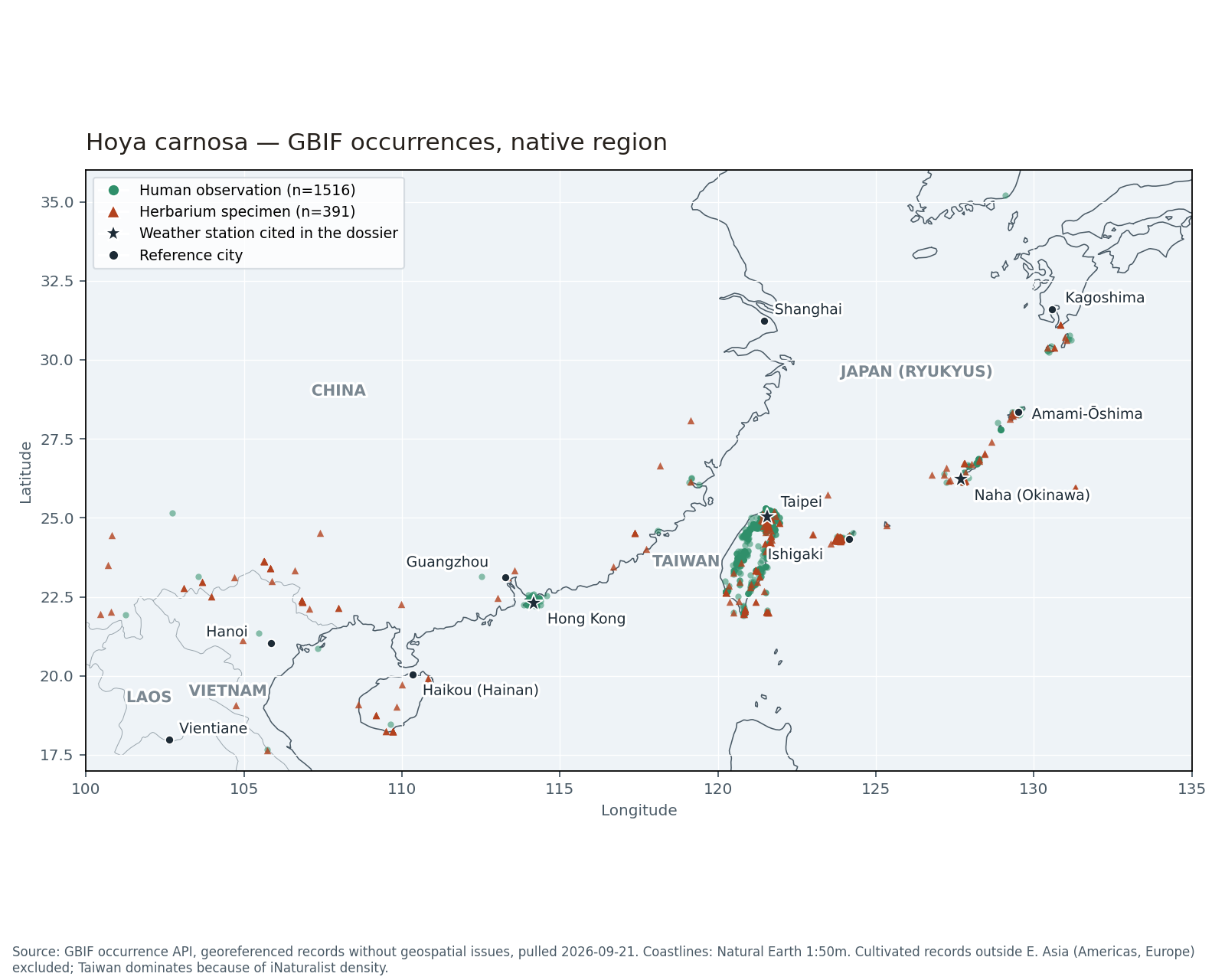 Distribution map — 1907 georeferenced GBIF records inside the native East-Asian window; cultivated records elsewhere excluded. Triangles = herbarium specimens; dots = human observations (iNaturalist etc.). Drawn 2026-09-21 from the GBIF occurrence API over Natural Earth coastlines.
Native range per WCVP/POWO: “S. China to Laos, Japan (S. Kyushu) to Taiwan.” Broken down by WCVP botanical region (P) [S1, S2]:
| Status | WCVP regions |
|---|---|
| Native | China South-Central; China Southeast; Hainan; Japan; Nansei-shoto (Ryukyu Islands); Taiwan; Laos |
| Native, doubtful | East Himalaya |
| Introduced | Korea; Bangladesh; Solomon Islands; Fiji; Trinidad-Tobago |
Flora of China gives the Chinese provinces as Fujian, Guangdong, Guangxi, Hainan, Taiwan, Yunnan, and adds in brackets “[India, ?Japan, Malaysia, Vietnam]”. (P) [S4]
Disagreements worth knowing (P/S):
- Vietnam and Malaysia are in FOC’s bracketed list but not in WCVP’s native list. [S2, S4]
- India: FOC lists it; WCVP says “East Himalaya (Doubtful)”. [S2, S4]
- Australia: not in WCVP at all. The Wikipedia claim that it occurs in Queensland is unsupported; the Australian wax plant is H. australis. [S2, S36]
- Fiji: introduced, and the Fijian H. intermedia A.C.Sm. is a synonym, so old “native to Fiji” statements trace to a naturalised plant. [S2]
- Japan: the Japanese sources put the northern limit at southern Kyushu, running down the Ryukyus. [S19]
GBIF occurrence data (backbone key 8658195, 2,626 records at query time; 1,629 human observations, 905 preserved specimens). Country counts are dominated by observation platforms, so they measure observer density as much as plant density (P for the numbers) [S6]:
| Country | Records | Comment |
|---|---|---|
| Taiwan | 1,354 | mostly iNaturalist; New Taipei, Taipei, Kaohsiung |
| Japan | 409 | Okinawa 230+, Kagoshima ~48 |
| Hong Kong | 180 | |
| China (mainland) | 135 | Yunnan 30, Guangxi 21, Hainan 11, Fujian 13, Guangdong 11, Xizang 1 |
| Brazil, USA, Colombia, Ecuador, Australia, Germany… | 80, 73, 20, 18, 17, 11 | cultivated / garden records |
| Vietnam, Laos, India | 9, 6, 9 | few |
Elevation (P for the source figures):
| Source | Range | Note |
|---|---|---|
| Flora of China | 200–1,200 m | “mountain forests, usually on trees” [S4] |
| Kunming Institute of Botany data via zh.wikipedia | 260–1,200 m | “on trees, plains and rocks” [S24] (S) |
| Taiwan (TaiEOL, citing 臺灣維管束植物簡誌) | “low elevations throughout Taiwan” | on rocks and tree trunks [S23] |
| GBIF Japan records with elevation (n = 165 in a 300-record sample) | 7–440 m | coastal to low hills, Okinawa and Kagoshima [S6] |
| GBIF mainland China records with elevation (n = 3) | 840–1,250 m | too few to mean much [S6] |
The picture: a lowland-to-lower-montane plant, sea-level coastal forest at its northern island limit, climbing to ~1,200 m on the continental margin.
3. Habitat and microhabitat
Growth form: WCVP/POWO lifeform “climbing epiphyte or lithophyte”, subtropical biome. FOC: “Shrubs epiphytic, climbing … Stems robust, to 6 m”. The genus description in FOC: “Subshrubs or lianas, epiphytic or epilithic, often twining or climbing by adventitious roots.” (P) [S1, S4, S5]
Forest type. FOC: “mountain forests, usually on trees.” Taiwan: shaded, moist forest interior and edge at low elevation, on trunks and stone walls. Japan: “near the coast, on rocky sites and in limestone forest” from southern Kyushu through the Ryukyus. (P/S) [S4, S19, S23]
Limestone. An Okinawan naturalist’s blog describes it as “very ordinary” in the limestone forests of northern Okinawa, gripping the rock with roots, and notes that although plants are abundant, flowering plants are hard to find because they flower only when hanging well out from cliff faces. That last observation is a single unreviewed field note, but it matches the pendent flowering habit growers see. (U) [S22]
Canopy position and light. The Taiwan field studies (a subtropical rain forest in north-eastern Taiwan, Taiwan Forestry Research Institute team with C.E. Martin) sampled individuals “within the canopies of host trees in open, exposed situations, as well as in dense forests.” Shade plants had much higher chlorophyll than sun plants, but the same chlorophyll a/b ratio; both groups ran CAM, and CAM was more consistent in the exposed plants. Conclusion: the species carries “adaptations to both high and low light levels”, as fits a vine whose leaves span the shade-to-sun gradient of one host crown. (P) [S16, S17]
Photosynthesis. H. carnosa is a CAM plant (night-time CO2 uptake, the succulent-plant water-saving mode). Under 10–12 days of severe water stress it shifts to “CAM-idling” (stomata shut, acid cycle continuing), holds that for at least 8 weeks, and returns to full CAM within a week of rewatering. That is the physiology behind its tolerance of neglect. (P) [S18]
Host trees and associated plants: no source I found names host species. The Taiwan CO2 study found no evidence that the vine uses host-respired CO2 at night. Dischidia formosana is its studied co-occurring epiphytic vine in the same Taiwan forest. (P for the Dischidia pairing; gap for hosts) [S16, S17]
4. Climate at the native sites
Four stations bracket the native range: Kagoshima (northern limit, mainland Kyushu), Naze on Amami-Oshima (the moth-pollination study island), Naha (Okinawa, the GBIF-densest Japanese area), Taipei (Taiwan’s densest records), and Hong Kong Observatory (the Guangdong coast). All are 1991–2020 normals from the national services (JMA; Central Weather Administration; Hong Kong Observatory). (P) [S25–S29]
Naha, Okinawa (JMA 1991–2020) [S25]
| Month | Max °C | Mean °C | Min °C | Rain mm | RH % | Sun h |
|---|---|---|---|---|---|---|
| Jan | 19.8 | 17.3 | 14.9 | 102 | 66 | 93 |
| Feb | 20.2 | 17.5 | 15.1 | 115 | 69 | 93 |
| Mar | 21.9 | 19.1 | 16.7 | 143 | 71 | 115 |
| Apr | 24.3 | 21.5 | 19.1 | 161 | 75 | 121 |
| May | 27.0 | 24.2 | 22.1 | 245 | 78 | 138 |
| Jun | 29.8 | 27.2 | 25.2 | 284 | 83 | 160 |
| Jul | 31.9 | 29.1 | 27.0 | 188 | 78 | 227 |
| Aug | 31.8 | 29.0 | 26.8 | 240 | 78 | 206 |
| Sep | 30.6 | 27.9 | 25.8 | 275 | 75 | 181 |
| Oct | 28.1 | 25.5 | 23.5 | 179 | 72 | 163 |
| Nov | 25.0 | 22.5 | 20.4 | 119 | 69 | 122 |
| Dec | 21.5 | 19.0 | 16.8 | 110 | 67 | 107 |
Taipei (CWA 1991–2020) [S26]
| Month | Max °C | Mean °C | Min °C | Rain mm | RH % | Sun h |
|---|---|---|---|---|---|---|
| Jan | 19.4 | 16.4 | 14.2 | 94 | 77 | 76 |
| Feb | 20.3 | 16.9 | 14.4 | 102 | 78 | 79 |
| Mar | 22.7 | 18.8 | 16.0 | 108 | 76 | 95 |
| Apr | 26.4 | 22.3 | 19.3 | 101 | 75 | 97 |
| May | 29.7 | 25.6 | 22.6 | 225 | 75 | 114 |
| Jun | 32.7 | 28.2 | 25.1 | 235 | 75 | 115 |
| Jul | 34.8 | 29.9 | 26.6 | 214 | 70 | 177 |
| Aug | 34.2 | 29.5 | 26.4 | 237 | 72 | 183 |
| Sep | 31.5 | 27.7 | 25.0 | 237 | 74 | 152 |
| Oct | 27.6 | 24.6 | 22.4 | 163 | 74 | 115 |
| Nov | 24.8 | 21.9 | 19.7 | 89 | 75 | 93 |
| Dec | 21.0 | 18.2 | 16.0 | 97 | 76 | 79 |
Hong Kong Observatory (1991–2020) [S27]
| Month | Max °C | Mean °C | Min °C | Rain mm | RH % | Sun h | Rain days |
|---|---|---|---|---|---|---|---|
| Jan | 18.7 | 16.5 | 14.6 | 33 | 74 | 146 | 5.7 |
| Feb | 19.4 | 17.1 | 15.3 | 39 | 79 | 102 | 8.0 |
| Mar | 21.9 | 19.5 | 17.6 | 75 | 82 | 100 | 10.5 |
| Apr | 25.6 | 23.0 | 21.1 | 153 | 83 | 113 | 11.4 |
| May | 28.8 | 26.3 | 24.5 | 291 | 83 | 139 | 15.4 |
| Jun | 30.7 | 28.3 | 26.5 | 492 | 82 | 144 | 19.3 |
| Jul | 31.6 | 28.9 | 26.9 | 386 | 81 | 197 | 18.4 |
| Aug | 31.3 | 28.7 | 26.7 | 453 | 81 | 182 | 17.5 |
| Sep | 30.5 | 27.9 | 26.1 | 321 | 78 | 174 | 14.9 |
| Oct | 28.1 | 25.7 | 23.9 | 120 | 73 | 198 | 7.8 |
| Nov | 24.5 | 22.2 | 20.3 | 39 | 72 | 172 | 5.7 |
| Dec | 20.4 | 18.2 | 16.2 | 29 | 70 | 162 | 5.3 |
Kagoshima, the northern limit (JMA 1991–2020) [S28]
| Month | Max °C | Mean °C | Min °C | Rain mm | RH % | Sun h |
|---|---|---|---|---|---|---|
| Jan | 13.1 | 8.7 | 4.9 | 78 | 66 | 133 |
| Feb | 14.6 | 9.9 | 5.8 | 113 | 65 | 139 |
| Mar | 17.5 | 12.8 | 8.7 | 161 | 66 | 163 |
| Apr | 21.8 | 17.1 | 12.9 | 195 | 68 | 176 |
| May | 25.5 | 21.0 | 17.3 | 205 | 71 | 178 |
| Jun | 27.5 | 24.0 | 21.3 | 570 | 78 | 109 |
| Jul | 31.9 | 28.1 | 25.3 | 365 | 76 | 186 |
| Aug | 32.7 | 28.8 | 26.0 | 224 | 74 | 207 |
| Sep | 30.2 | 26.3 | 23.2 | 223 | 72 | 176 |
| Oct | 25.8 | 21.6 | 18.0 | 105 | 67 | 184 |
| Nov | 20.6 | 16.2 | 12.2 | 103 | 68 | 158 |
| Dec | 15.3 | 10.9 | 6.9 | 93 | 67 | 143 |
Naze, Amami-Oshima (JMA 1991–2020; daily mean and rain only, the max/min columns did not extract cleanly) [S29]: Jan 15.0 °C / 184 mm; Apr 19.8 / 214; May 22.8 / 278; Jun 26.2 / 427; Jul 28.8 / 215; Sep 27.0 / 346; Oct 23.9 / 261; Dec 16.7 / 170. Humidity 68–80 %.
Reading the tables:
- Winters are cool, not cold: monthly means 16–19 °C on Okinawa, Taipei and Hong Kong, with typical nights 14–16 °C. Kagoshima, at the extreme northern limit, sees January nights near 5 °C, which is why the Japanese literature calls this the hardiest hoya (to about 5 °C). (P/S) [S19, S25–S28]
- Summers are hot and wet: means 27–30 °C, nights 25–27 °C, humidity 75–83 %.
- The dry season is winter on the continental coast (Hong Kong: 29–39 mm a month Nov–Feb, 5–6 rain days). The islands have no true dry season; Naha’s driest month still gets ~100 mm.
- The wettest, most humid stretch is May–June (the East Asian plum rains), then the typhoon season into September.
- Winter sunshine is low on Taipei and Naha (76–93 h a month) and the summer sun is roughly double that.
5. Phenology
Flowering in situ (P/S):
| Region | Months | Source |
|---|---|---|
| Amami-Oshima (Kagoshima Pref.) | June, listed under mountain plants in the city’s native-flowering calendar | [S20] |
| Okinawa | May (northern-Okinawa limestone forest, in flower May 2016); the Japanese Wikipedia says “summer” | [S19, S22] |
| Ishigaki (Yaeyama) | in flower 9 June 2026 (news report) | [S21] |
| Taiwan | April–August (Taiwanese horticultural sources) | (S) [S24 search context] |
| Mainland China | “spring” (zh.wikipedia); FOC gives no flowering months | (S) [S4, S24] |
So the native season centres on May–July, opening earlier in the warmer south. Each umbel in cultivation opens over 2–3 weeks and the flowers of one umbel last about a week; sources for these figures are hobby-grade, not measured. (U) [S31, S38]
Trigger. No controlled study of what induces flowering in H. carnosa turned up. The circadian work shows the flower’s scent clock is entrained by the flower’s own local light/dark cycle, independent of the rest of the plant, but that governs daily timing, not seasonal induction. Claims about photoperiod thresholds (for example “below 12.5 h”) or specific night-temperature drops circulate on commercial care sites without a cited experiment. Treat them as unverified. (U) [S8]
Peduncle (spur) reblooming. FOC’s genus description: inflorescences “producing a succession of globose or flat-topped clusters; old rachis thick, with contiguous pedicel scars.” That is the wild trait: the peduncle is perennial and each flowering adds pedicel scars to a lengthening rachis. Kloppenburg’s Philippine monograph adds that perennial peduncles bear successive umbels “once a year or as often as about every 45 days”, may last “for several years or until the plant is stressed”, and that a single peduncle can produce hundreds of flowers in its life. So the horticultural rule “never cut the spur” is a direct reading of the inflorescence anatomy. (P for FOC; S for Kloppenburg) [S5, S41]
New growth: no source gives a month for shoot initiation in situ. The Japanese cultivation note that cuttings root best May–September implies the active-growth season is the warm half-year. (S) [S19]
6. Reproductive biology
Flower morphology (FOC, P) [S4]: pseudumbels extra-axillary, globose, about 30-flowered, pubescent; peduncle about 4 cm; pedicels 2–4 cm. Corolla white, sometimes with a pink centre, rotate, 1.5–2 cm across; lobes triangular, densely papillate inside, margins recurved, tips reflexed. Corona lobes stellate and spreading, outer angle acute, middle ridge prominent, margin strongly reflexed enclosing a hollow at the base, inner angle acute and lying on the anthers. Stigma head obtuse. Follicles linear-lanceolate, 6–10 × 0.5–1.5 cm; seeds ~5 × 1 mm with a 2.5 cm coma (silky parachute). Japanese sources describe the umbel as a 5–7 cm hemisphere-to-ball of 1.5 cm flowers with a red centre to the corona. (S) [S19]
Pollinaria: two erect oblong pollinia per pollinarium with a raised translucent margin (the pellucid crest that engages the guide rail). (P) [S5]
Pollination in the wild, the key paper: Mochizuki, Furukawa and Kawakita 2017, American Journal of Botany 104: 953–960, observing on Amami-Oshima 2013–2015. Flowers were visited by various settling moths at night. Pollinia attachment was found “predominantly on the legs of the large moth Erebus ephesperis (Noctuidae) and less frequently on the legs of the medium-sized moths Bastilla arcuata and Cleora injectaria.” The moths walked around the inflorescence hunting nectar, and the corpusculum clipped onto the arolia (adhesive tarsal pads) as they stepped between the coronas. The downward-facing ball of flowers with “flat, velvety petals and a slippery corona” gives restricted footholds that funnel legs onto the pollinaria. This is a new mechanism for the asclepiads, which are classically pollinated by mouthparts. (P) [S7]
Pollinia deposition appears rare per flower but is compensated because moths “usually stay for several hours and keep moving on an inflorescence.” (P, abstract-level) [S7]. Landrein et al. 2021 compared several species and note that in H. carnosa the guide rail “lacks a landing platform”, which may explain why only strong, large moths pollinate it effectively; in H. pottsii the dominant scent was linalool, methyl benzoate and benzaldehyde, classic moth attractants. (P) [S12]
Scent: nocturnal, on an endogenous circadian clock. Altenburger and Matile 1988 (Planta 174: 248–252) showed emission continues rhythmically for 2–3 cycles in constant light with a free-running period of about 29 h, re-entrains within one cycle to an inverted light/dark cycle, and that a single flower entrains to its own light regime even when the rest of the plant is on the opposite one. The 1990 follow-up showed the rhythm persists in permanent darkness with temperature compensation, and identified an unusual sesquiterpene previously known only from cardamom oil. (P) [S8, S9]
Scent chemistry: H. carnosa “emits only methyl salicylate” as its methyl ester, with its enzyme showing ten-fold preference for salicylic acid over benzoic acid (Effmert et al. 2005). A wider volatile list (eucalyptol, linalool, limonene, ocimene, pinene; caryophyllene, farnesene, geranyl acetone, ionone; acetophenone, benzaldehyde, benzyl alcohol, methyl salicylate, 2-phenylethanol) surfaced in a search summary but I could not open the paper that lists it. (P for methyl salicylate; U for the full list) [S11]
Nectar: Matile 2006 (Botanica Helvetica 116: 1–7) sampled at 3-hour intervals over several days and found “an oscillating secretion with maxima around midnight”, i.e. nectar and scent both peak at night. Volumes and sugar concentrations are behind the paywall. The dripping “honeydew” growers see is this nectar. (P for the rhythm; gap for quantities) [S10, S32]
Self-compatibility: no study found. Seed set on isolated cultivated plants is not documented in any source I reached. (gap)
7. Growth habit and morphology
Stems robust, to 6 m in the wild, pale grey, smooth; the plant is glabrous except the inflorescence. Petiole 1–1.5 cm; blade broadly ovate-cordate to ovate-oblong or elliptic, 3.5–13 × 3–5 cm, base rounded to shallowly cordate, tip obtuse or shortly acuminate, lateral veins about 4 pairs and obscure. Leaves are fleshy; var. gushanica has silver-spotted leaves and puberulent ovaries, var. carnosa is plain deep green. (P) [S4]
Roots: climbing by adventitious roots from the nodes (genus character); Japanese sources describe roots from the stem running out onto trunks and gripping limestone. (P/S) [S5, S19, S22]
Leaf succulence and CAM go together in this species; a Taiwan study paired it with Dischidia formosana to test the succulence–CAM link. (P) [S17]
Longevity: no source gives a lifespan for wild plants. Kloppenburg’s note that peduncles persist “for several years” and the Missouri Botanical Garden’s “long lived house plant” are the only longevity statements found. (gap) [S40, S41]
Wild versus a decades-old cultivated plant: the wild plant is a 6 m liana spread over bark and rock with many leaves in sun and many in shade, running CAM harder where exposed. A hanging-basket plant is the same organism with its stems looped into a metre or two and its whole canopy at one light level, so the plant depends on the grower’s light to reach the exposed-leaf state that, per the Taiwan work, is where CAM and (by inference) carbohydrate surplus are strongest. The inference from CAM to flowering is mine, not the paper’s. (P for the physiology; my inference flagged)
8. Conservation status and naturalisation
IUCN Red List: not assessed. No entry for H. carnosa appears on iucnredlist.org; the National Tropical Botanical Garden database lists it as “IUCN: Not Evaluated”. Other hoyas are assessed (e.g. H. pandurata Vulnerable, H. bhutanica Endangered), so the absence is a real gap rather than a search miss. (P/S) [S35]
National lists: no Chinese, Taiwanese or Japanese red-list status found. The Japanese and Taiwanese sources describe it as common in its habitat. (S) [S19, S22, S23]
Naturalised: WCVP records it as introduced in Korea, Bangladesh, the Solomon Islands, Fiji and Trinidad-Tobago. GBIF holds only a single record flagged “introduced”. No source lists it as invasive anywhere. (P) [S2, S6]
9. Identification key for the grower
The bloom is the evidence. Colour pattern of corolla plus corona is the practical decider; leaf shape backs it up. Corolla surface will not separate carnosa from pubicalyx, because both are papillose/velvety inside (FOC says “densely papillate inside” for carnosa; the pubicalyx description says “internally densely papillose”). Scent will not separate them either.
| Feature | H. carnosa | H. pubicalyx | H. australis | H. obovata | H. lacunosa | H. carnosa ‘Compacta’ and variegates |
|---|---|---|---|---|---|---|
| Corolla colour | white to pale pink, sometimes pink at centre (P) [S4] | light red to dark rose, purple, near-black (S) [S37] | white/cream with red under the corona (P) [S36] | pale pink (S) [S42] | white to greenish-yellow (S) [S42] | as species |
| Corolla surface | flat, velvety/papillate inside, margins recurved (P) [S4, S7] | glabrous outside, densely papillose inside (S) [S37] | minutely hairy above (P) [S36] | densely hairy (S) [S42] | ring of velvety hair inside, lobes strongly reflexed (S) [S42] | as species |
| Corona | stellate, white/pale, centre red to purple (P/S) [S4, S19, S40] | brown, shining, 10–12 mm, star-shaped; often pink tinged dark red (S) [S37] | white/cream segments (P) [S36] | darker pink than corolla (S) [S42] | yellow, ovate lobes (S) [S42] | as species |
| Flower size | 1.5–2 cm across (P) [S4] | ~1.8 cm (S) [S37] | 15–25 mm (P) [S36] | to 1.5 cm (S) | ~0.8 cm (S) [S42] | as species |
| Umbel | globose, ~30 flowers, 5–7 cm ball, pendent (P/S) [S4, S19] | many-flowered, 8–9 cm (S) [S37] | 12–30 flowers (P) [S36] | ~20 flowers (S) | up to 30 tiny flowers, ~7 cm hanging cluster (S) [S42] | as species |
| Scent | sweet, night-peaking, methyl salicylate note (P) [S8, S11] | fragrant (S) [S37] | strong sweet (S) | fragrant (S) | cinnamon, mostly at night (S) [S42] | as species |
| Nectar | copious, drips, night maximum (P) [S10] | present (S) | abundant (S) | present (S) | little reported (U) | as species |
| Leaf | broadly ovate-cordate to elliptic, 3.5–13 × 3–5 cm, thick, plain green or silver-spotted (var. gushanica) (P) [S4] | oblong to oblong-obovate, 10–14 × 3–6 cm, thinner, usually silver-splashed (S) [S37] | broad-elliptic to circular, 3–6 × 2–5 cm, hairy beneath (P) [S36] | round/obovate ~9 × 9 cm, veinless, silver-flecked (S) [S42] | small 2–7 × 1–3 cm, dimpled between veins (S) [S42] | ‘Compacta’: folded, curled, crowded; ‘Tricolor’/‘Rubra’: cream or pink variegation (S) [S30, S31] |
| Stem | robust, glabrous (P) [S4] | slender, vining (S) | hairy (P) [S36] | slender, small | as species |
The decider: a pendent ball of white-to-pale-pink, velvet-surfaced stars, each with a pale star corona whose centre is red to purple, on thick plain-green (or silver-flecked) broadly ovate leaves 3–5 cm wide. If the corollas are dark rose, purple or near-black with a brown-shining corona and the leaves are longer, thinner, oblong and heavily silver-splashed, it is H. pubicalyx. A cream flower with a white corona and a red blotch only under it, on a hairy stem, is H. australis. Tiny white reflexed flowers with a yellow corona and a cinnamon scent are H. lacunosa.
Two cautions. First, pubicalyx has pale cultivars and carnosa has darker-pink forms, so use the corona centre and the leaf together, not the corolla alone. Second, the 2006 ITS result shows these two species can share genetic material, so a hobbyist-traded plant can be an intermediate; a grandmother’s cutting from the mid-20th-century Midwest trade is far more likely the plain species than any pubicalyx form, but that is a provenance argument, not a botanical one. (U for the provenance claim)
10. What this means for reading the cultivated plant
A September bloom sits at the tail of the native calendar. In situ the species flowers May through July on the Ryukyus and April through August in Taiwan, in the warmest, wettest, most humid part of the year (Naha June: mean 27 °C, nights 25 °C, 83 % humidity, 284 mm rain). The indoor plant under grow lights is not tracking that season; its light and temperature are flat year round, so the plant flowers when its own internal state allows rather than on the wild schedule. There is no evidence that the plant needs a dry or cool spell to flower: in the wild it blooms in the rains, after a cool winter that is the drier season on the continental coast and merely less wet on the islands. (P for the climate and phenology; the reading is mine)
What the wild flowering plant experiences: night temperatures 22–27 °C, humidity 75–83 %, very high rainfall, a canopy or cliff position where some leaves are fully exposed, and umbels hanging free in the air where large moths can land and walk. The Okinawan field note that flowering is seen mainly on stems hanging out from cliffs, and the Amami finding that the pendent ball shape is itself part of the pollination mechanism, both say the same thing: hanging growth is where this species flowers. A hanging pot suits it. (P for the pollination biology; U for the cliff observation)
Decades-old, root-bound heirlooms and irregular bloom. The horticultural literature that exists is extension-grade rather than experimental, but it is consistent: hoyas “commonly flower better when slightly potbound”; light “is the primary driver, and many plants that never bloom simply are not receiving enough light indoors”; plants “take several years to reach maturity”; buds drop if the plant is moved after bud set; and the spurs are perennial and must never be removed. Vermont Hoyas describes H. carnosa as the plant that “can take a lot of abuse”, tolerates staying in the same pot for years, and is “not an early bloomer” (about three years from cutting). Nothing in these sources says old plants become irregular; the pattern they describe is that bloom follows light, and that an old plant kept at one location and one pot will bloom when the light is finally enough. The physiology supports this: it is a CAM vine that survives 8 weeks of stomatal closure, so a root-bound, under-watered heirloom is not stressed in any way the plant registers as unusual. (S for the extension statements; P for the CAM physiology) [S18, S38, S39, S40]
The first bloom on record, this September, after decades: the most parsimonious reading from the sources is that the grow lights delivered the exposed-leaf light state the wild plant reaches in its host crown, and the peduncles that had been waiting did their perennial job. Expect the same spurs to carry the next umbels; the wild rachis lengthens with each flowering. (P for the rachis anatomy; the reading is mine)
Sources
- POWO, Hoya carnosa (L.f.) R.Br. — https://powo.science.kew.org/taxon/urn:lsid:ipni.org:names:107308-3 — native range summary, lifeform, biome (page blocked direct fetch; text read from search index; data mirrored by S2).
- World Flora Online, Hoya carnosa, WCVP distribution and synonymy — https://www.worldfloraonline.org/taxon/wfo-0000725176 — native/introduced regions, full synonym list, FOC description copy.
- IPNI, Hoya carnosa — https://www.ipni.org/n/107308-3 — protologue citation, basionym citation and date.
- Flora of China, Hoya carnosa — https://www.efloras.org/florataxon.aspx?flora_id=2&taxon_id=200018633 — full description, 200–1,200 m, provinces, varieties, 2n = 22.
- Flora of China, genus Hoya — https://www.efloras.org/florataxon.aspx?flora_id=2&taxon_id=115819 — adventitious roots, perennial rachis with pedicel scars, pollinarium.
- GBIF backbone match and occurrence API — https://api.gbif.org/v1/species/match?name=Hoya%20carnosa and https://api.gbif.org/v1/occurrence/search?taxonKey=8658195&facet=country — record counts by country and basis, elevation values; species page https://www.gbif.org/species/8658195.
- Mochizuki K., Furukawa S., Kawakita A. 2017. Pollinia transfer on moth legs in Hoya carnosa. American Journal of Botany 104: 953–960 — https://doi.org/10.3732/ajb.1700078 (abstract via Europe PMC) — moth pollinators, mechanism, Amami-Oshima.
- Altenburger R., Matile P. 1988. Circadian rhythmicity of fragrance emission in flowers of Hoya carnosa. Planta 174: 248–252 — https://doi.org/10.1007/BF00394778 — night scent clock, 29 h free-run, flower-level entrainment.
- Altenburger R., Matile P. 1990. Further observations on rhythmic emission of fragrance in flowers. Planta 180 — https://doi.org/10.1007/BF00193995 — persistence in darkness, temperature compensation, cardamom sesquiterpene.
- Matile P. 2006. Circadian rhythmicity of nectar secretion in Hoya carnosa. Botanica Helvetica 116: 1–7 — https://doi.org/10.1007/s00035-006-0740-4 — nectar maxima around midnight.
- Effmert U. et al. 2005. Floral benzenoid carboxyl methyltransferases. Phytochemistry — https://pmc.ncbi.nlm.nih.gov/articles/PMC2864587/ — H. carnosa emits only methyl salicylate; cites S8.
- Landrein S., Zhou Z.-Y., Song S.-J. 2021. Pollinators of Hoya pottsii: are the strongest the most effective? Flora — https://www.sciencedirect.com/science/article/abs/pii/S0367253020302334 — guide rail of H. carnosa lacks a landing platform; moth-attractant scent profile.
- Wanntorp L., Kocyan A., Renner S.S. 2006. Wax plants disentangled. Molecular Phylogenetics and Evolution 39: 722–733 — https://doi.org/10.1016/j.ympev.2006.01.022 — ITS of H. carnosa grouping with H. pubicalyx; “at least 200 species”.
- Wanntorp L. et al. 2006. Towards a monophyletic Hoya. Systematic Botany 31: 586–596 — https://doi.org/10.1600/036364406778388593 — genus delimitation.
- Wanntorp L. et al. 2014. Wax plants (Hoya) evolution: epiphytism drives successful radiation. Taxon 63: 89–102 — https://doi.org/10.12705/631.3 — six clades, “over 300 species”, Clade VI outposts in Japan.
- Hsu C.C., Lin T.C., Chiou W.L., Lin S.H., Lin K.C., Martin C.E. 2006. Canopy CO2 concentrations and CAM in Hoya carnosa in a subtropical rain forest in Taiwan. Photosynthetica 44: 130 — http://ps.ueb.cas.cz/artkey/phs-200601-0018_canopy-co2-concentrations-and-crassulacean-acid-metabolism-in-hoya-carnosa-in-a-subtropical-rain-forest-in-taiw.php — canopy positions, no host-CO2 use.
- Martin C.E., Hsu R.C.-C., Lin T.-C. 2010. Sun/shade adaptations of the photosynthetic apparatus of Hoya carnosa. Acta Physiologiae Plantarum 32: 575–581 — https://doi.org/10.1007/s11738-009-0434-9 — sun vs shade, CAM stronger when exposed.
- Rayder L., Ting I.P. 1983. CAM-idling in Hoya carnosa. Photosynthesis Research — https://doi.org/10.1007/BF00052124 — drought physiology.
- Japanese Wikipedia, サクララン — https://ja.wikipedia.org/wiki/サクララン — Japanese range, coastal/limestone habitat, summer flowering, hardiness, cutting season.
- Amami City native-plant flowering calendar — https://www.city.amami.lg.jp/bunka/kyoiku/bunka/bunkazai/j-calendar.html — June.
- Okinawa Times, 14 June 2026, Sakuraran in flower at Banna Park, Ishigaki — https://www.okinawatimes.co.jp/articles/-/1858670 — June flowering, flower description.
- Curious Okinawa blog, 21 May 2016 — http://curiousokinawa.com/blog/2016/05/21/sakurarann/ — limestone-forest abundance, flowering on cliff-hanging stems (unreviewed).
- TaiEOL, 毬蘭 Hoya carnosa — https://taieol.tw/pages/42316/articles — Taiwan description, low-elevation habitat on rocks and trunks.
- Chinese Wikipedia, 球兰 — https://zh.wikipedia.org/zh-tw/球兰 — 260–1,200 m (Kunming Institute of Botany data).
- Wikipedia, Naha (climate table, JMA 1991–2020) — https://en.wikipedia.org/wiki/Naha
- Wikipedia, Taipei (climate table, CWA 1991–2020) — https://en.wikipedia.org/wiki/Taipei
- Hong Kong Observatory, climatological normals 1991–2020 — https://www.hko.gov.hk/en/cis/normal/1991_2020/normals.htm
- Wikipedia, Kagoshima (climate table, JMA 1991–2020) — https://en.wikipedia.org/wiki/Kagoshima
- Wikipedia, Amami, Kagoshima (Naze climate table, JMA 1991–2020) — https://en.wikipedia.org/wiki/Amami,_Kagoshima
- HoyaCultivars.org (International Cultivar Registration Authority for Hoya), ‘Tricolor’ and ‘Rubra’ — https://hoyacultivars.org/tricolor/ and https://hoyacultivars.org/rubra/ — patents, trademarks, dates, ‘Chelsea’.
- Wikipedia, Hoya carnosa — https://en.wikipedia.org/wiki/Hoya_carnosa — ‘Compacta’ origin (citing Drysdale 1992 and USPTO), umbel counts, nectar (secondary).
- LLIFLE, Hoya carnosa cv. Krimson Queen — https://www.llifle.com/Encyclopedia/SUCCULENTS/Family/Asclepiadaceae/27672/Hoya_carnosa_cv._Krimson_Queen — cultivar relationships, nectar drop per flower.
- POWO, Hoya compacta C.M.Burton — https://powo.science.kew.org/taxon/urn:lsid:ipni.org:names:940449-1 — synonym of H. carnosa; Hoyan 12(2:2): ii (1990).
- Wikipedia, List of Hoya species — https://en.wikipedia.org/wiki/List_of_Hoya_species — 562 species + 1 hybrid in POWO as of April 2026.
- National Tropical Botanical Garden database, Hoya carnosa — https://ntbg.org/database/plants/detail/hoya-carnosa — IUCN Not Evaluated (its range list is Hortus Third-derived and unreliable).
- PlantNET (NSW Flora Online), Hoya australis — https://plantnet.rbgsyd.nsw.gov.au/cgi-bin/NSWfl.pl?page=nswfl&lvl=sp&name=Hoya~australis — description for the key.
- Hoya pubicalyx: POWO https://powo.science.kew.org/taxon/urn:lsid:ipni.org:names:98653-1 (Merr., Philipp. J. Sci. C 13: 331, 1918; Luzon); Hoya Obsession NZ description transcription https://hoya-obsession.com/blogs/news/hoya-pubicalyx; Vermont Hoyas https://vermonthoyas.com/2014/08/14/daughter-of-hoya-pubicalyx-purple-hybrid-is-just-another-h-carnosa/ — flower and leaf contrasts.
- Vermont Hoyas, Hoya carnosa — https://vermonthoyas.com/hoyas-a-m/hoya-carnosa/ — “grandmother’s plant”, tolerance, ~3 years to bloom.
- Iowa State University Extension, All About Hoyas — https://yardandgarden.extension.iastate.edu/how-to/all-about-hoyas — peduncles, pot-bound, light as primary driver.
- Missouri Botanical Garden Plant Finder, Hoya carnosa — https://plantfinder.mobot.org/PlantFinderDetails.aspx?taxonid=276833 — red-centred corona, 10–30 flowers, do not remove spur, do not move after buds, genus etymology.
- Kloppenburg D. Philippine Hoya Species: a monograph (Internet Archive text) — https://archive.org/stream/phillipinehoyasp00klop/phillipinehoyasp00klop_djvu.txt — perennial peduncle behaviour (use with caution).
- World of Succulents, Hoya obovata https://worldofsucculents.com/hoya-obovata/ and NC State Extension, Hoya lacunosa https://plants.ces.ncsu.edu/plants/hoya-lacunosa/ — comparison rows (secondary).
- Wanntorp L. et al. 2020. Phylogenetic studies in the Hoya group: the position of Anatropanthus and Oreosparte. Willdenowia 50 — https://bioone.org/journals/willdenowia/volume-50/issue-1/wi.50.50112/Phylogenetic-studies-in-the-Hoya-group-Apocynaceae-Marsdenieae—the/10.3372/wi.50.50112.full — sentence placing H. carnosa, type of sect. Hoya, in Clade VI.
Unverified / gaps
- POWO and ScienceDirect blocked direct fetches; POWO data were read through World Flora Online’s WCVP mirror and search-index text. The 562-species count is via Wikipedia’s compilation of POWO.
- Flowering months in situ rest on Japanese municipal and news sources and Taiwanese horticultural pages; no flora gives months, and no phenology study exists.
- No experiment on what induces flowering (photoperiod, temperature, drought). Care-site thresholds are unverified.
- Nectar volume and sugar concentration (Matile 2006) are behind a paywall; only the midnight maximum is confirmed.
- The full floral-volatile list attributed to H. carnosa could not be traced to its paper; only methyl salicylate is confirmed.
- Host tree species, associated epiphytes, and the named Taiwan study forest (likely Fushan, TFRI, but not stated in any abstract I could read).
- Self-compatibility and seed set of isolated plants: no source.
- Lifespan of wild individuals: no source.
- The “flowers only when hanging from cliffs” observation is a single blog note.
- ‘Krinkle Kurl’ as a Cobia re-marketing of ‘Compacta’ is hobby lore, not registrar-confirmed.
- The claim that H. carnosa is the type species of the genus Hoya (not just of sect. Hoya) is widely stated but I did not verify it in a fetched primary source.
- Naze (Amami) daily max/min columns did not extract reliably and were omitted.
- Guangzhou was not tabulated; Hong Kong Observatory stands in for the Guangdong coast.