Pleurothallis costaricensis — in situ dossier
Summary. The plant grown here as Pleurothallis costaricensis is, under the current Kew and GBIF (Global Biodiversity Information Facility) backbone, Specklinia costaricensis (Rolfe) Pridgeon & M.W.Chase, transferred in 2001 from Pleurothallis costaricensis Rolfe (1917); the type was sent to Kew by Charles Lankester from near Cachí, Cartago, and flowered there in May 1916. It is a caespitose mini-miniature epiphyte with filiform ramicauls, narrow coriaceous leaves of 4–5 cm, and a loose raceme, longer than the leaf, of 6–12 small yellow flowers described by Rolfe as light greenish yellow with darker nerves. Kew gives the range as Costa Rica to western Ecuador (Costa Rica, Panama, Colombia, Ecuador); the Costa Rican core of the herbarium record is the Cordillera de Tilarán (Monteverde, San Ramón), the Cordillera Central and the Pacific side of Talamanca, at a median of about 1,350 m (quartiles roughly 1,040–1,550 m), on mossy trunks, limbs and fallen branches in cloud forest and premontane-to-lower-montane rain forest on both slopes of the divide. Herbarium and iNaturalist flowering records fall in every quarter of the year, with a visible September cluster in Costa Rica, and the wild population sits in its wettest, cloudiest, most thermally even months in September. Pollination has not been studied in this species; the genus is fly-pollinated, with Drosophila documented in a related Costa Rican group. It is not evaluated by IUCN and is traded under CITES Appendix II like all orchids. A mid-September flowering with no rest applied is consistent with everything the sources say about this plant.
Confidence key used below: [P] verified in a primary or near-primary source (journal paper, taxonomic database, herbarium label, protologue); [S] secondary (flora summaries, Wikipedia transcriptions of official data, nursery pages, search-engine excerpts of a page that could not be fetched directly); [U] unverified or inferred.
Acronyms used: POWO = Plants of the World Online (Kew); IPNI = International Plant Names Index; GBIF = Global Biodiversity Information Facility; JBL = Jardín Botánico Lankester (Lankester Botanical Garden, University of Costa Rica); IOSPE = Internet Orchid Species Photo Encyclopedia (orchidspecies.com); IMN = Instituto Meteorológico Nacional (Costa Rica’s national weather service); INBio = Instituto Nacional de Biodiversidad (Costa Rica, herbarium now at the Museo Nacional); IUCN = International Union for Conservation of Nature; CITES = Convention on International Trade in Endangered Species; PPFD = photosynthetic photon flux density; CRU = Climatic Research Unit (University of East Anglia).
1. Taxonomy and nomenclature
Accepted name: Specklinia costaricensis (Rolfe) Pridgeon & M.W.Chase, published in Lindleyana 16: 257 (2001). Kew’s POWO page could not be fetched directly (Cloudflare block), but Kew’s own ColPlanta mirror of the same record, the GBIF backbone, and the JBL Epidendra database all agree on this name and citation [P] [1] [2] [3] [7].
Basionym: Pleurothallis costaricensis Rolfe, Bulletin of Miscellaneous Information, Kew 1917(2): 80, published 11 August 1917, in the series “New Orchids: Decade XLV”, no. 441 [P] [5] [6]. Rolfe placed it in Pleurothallis § Apodae caespitosae and compared it to P. longissima Lindl., separating it by the smaller leaves and the connate lateral sepals with minutely denticulate apex [P] [6].
Heterotypic synonym: Pleurothallis ehrhartiiflora Schltr., Repertorium Specierum Novarum Regni Vegetabilis, Beihefte 19: 187 (1923) [P] [2] [3].
Type: C. H. Lankester 21, Costa Rica, near Cachí (Paraíso canton, Cartago province), sent to Kew in 1915 and flowered in the Kew collection in May 1916; holotype at K (Kew). Epidendra also records spirit and silica material, DNA sequence data and a JBL photograph (jbl_11506) [P] [6] [7]. Ames (Harvard) holds material labelled “clonotype” from the same Lankester sending [P] [4].
Name trap: there is a later homonym, Pleurothallis costaricensis Schltr. (1918), which is a synonym of the large-leaved Pleurothallis cardiothallis Rchb.f.; Ames renamed Schlechter’s plant P. schlechteriana in 1923. Some nursery pages (Isle of Portland, orchids.org) wrongly credit “Schltr. 1917” for Rolfe’s species. Only Rolfe’s name is the basionym of Specklinia costaricensis [P] [5] [32].
Infrageneric placement:
| Author | Placement | Confidence |
|---|---|---|
| Rolfe 1917 | Pleurothallis § Apodae caespitosae | [P] [6] |
| Luer 1986 / 2006 (Icones Pleurothallidinarum), as reported by IOSPE | Pleurothallis subgen. Specklinia sect. Hymenodanthae subsect. Longicaulae | [S] [11] |
| Pridgeon & Chase 2001 | Specklinia (genus resurrected on DNA evidence) | [P] [3] [10] |
| Karremans et al. 2016 | Specklinia recircumscribed, five subgenera: Specklinia, Sylphia, Hymenodanthae, Acostaea (later renamed Dresslera), Sarcinula | [P] [8] [9] [10] |
| This species within Karremans’ scheme | Presumably subgen. Hymenodanthae (lectotype P. grobyi, the same type as Luer’s subsect. Longicaulae); the 2016 species lists were not accessible to confirm | [U] |
The 2016 reassessment used nuclear ITS and plastid matK sequence data, found the old Specklinia paraphyletic, sank ten small genera into it (Acostaea, Areldia, Empusella, Cucumeria, Gerardoa, Pseudoctomeria, Sarcinula, Sylphia, Tribulago, Tridelta), and recovered Specklinia as sister to a clade of Platystele, Scaphosepalum and Teagueia [P] [8]. Note that Playstele stenostachya in the terrarium is therefore a close relative.
Genus size: “about 100” species in Karremans et al. 2016 [P] [8]; “just under 120 described species” in the 2026 Mexican revision [P] [10]; 109 accepted in POWO as of 2025 per Wikipedia [S] [31]. The genus ranges from Mexico to Bolivia and southern Brazil, including the Antilles [P] [10].
Subtribe: Pleurothallidinae (tribe Epidendreae, subfamily Epidendroideae) [P] [8] [10].
2. Distribution
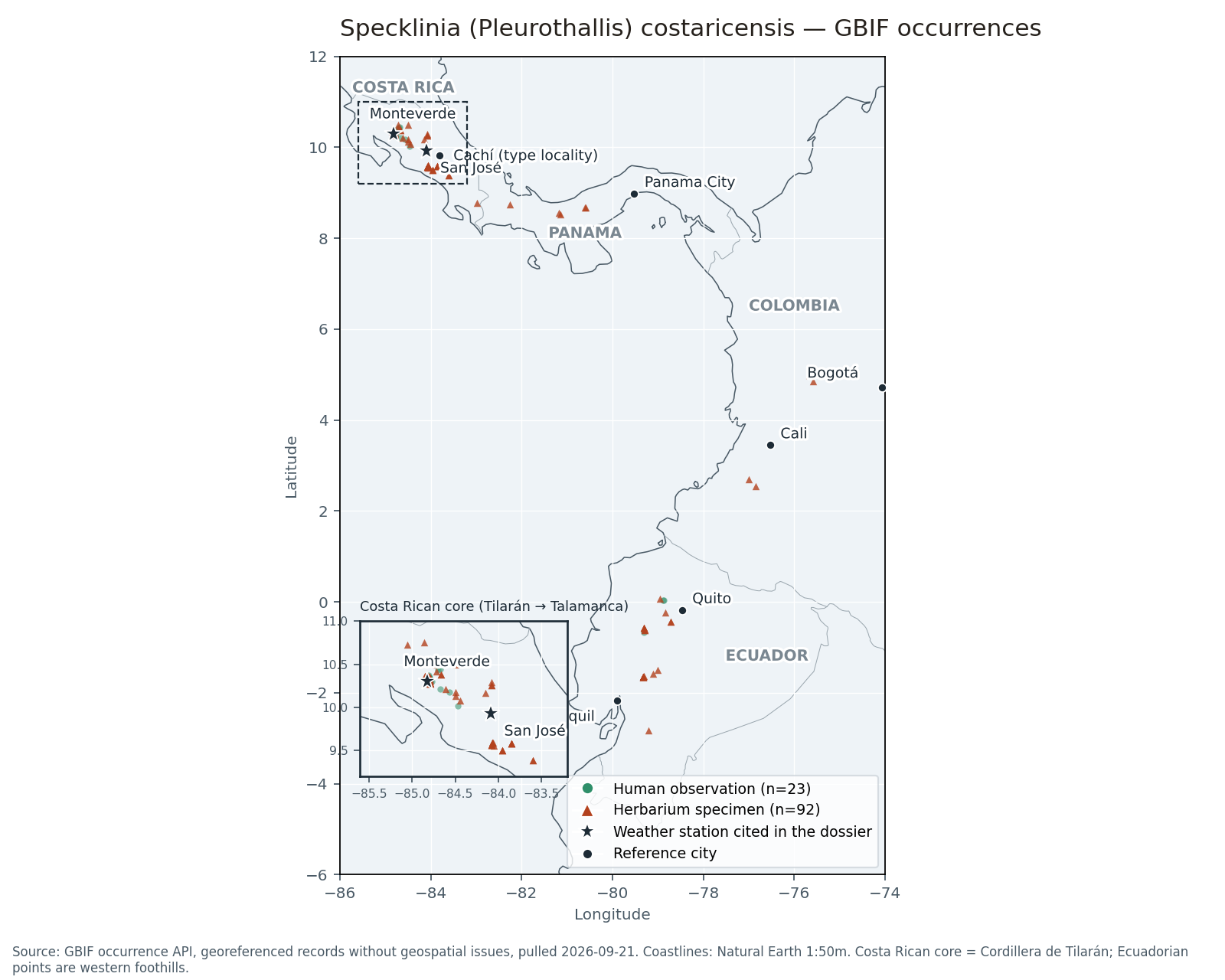 Distribution map — 115 georeferenced GBIF records (Costa Rica, Panama, Colombia, Ecuador, Peru). Triangles = herbarium specimens; dots = human observations (iNaturalist etc.). Drawn 2026-09-21 from the GBIF occurrence API over Natural Earth coastlines.
Kew’s range statement: “Costa Rica to W. Ecuador”, with the distribution list Colombia, Costa Rica, Ecuador, Panamá; lifeform epiphyte; biome “wet tropical” [P] [2]. IOSPE gives only Costa Rica (Cartago) and Panama [S] [11]. Nicaragua is not listed anywhere consulted.
GBIF holds 236 occurrence records for the accepted name (204 preserved specimens, 23 human observations, 6 living specimens, 3 material samples). Country counts: Costa Rica 140, Ecuador 52, Colombia 11, Panama 6, Peru 1, Belgium 2 (cultivated, Meise garden). Major holding institutions: MO (Missouri), AMES (Harvard), K (Kew), INBio, SEL (Selby), S (Stockholm), W (Vienna), NY [P] [4].
Costa Rican provinces in GBIF (specimens and observations): Alajuela 25, Puntarenas 24, San José 20, Guanacaste 19, Heredia 9, and 43 records without a province field. Named localities cluster in the Monteverde–San Luis–San Gerardo–Peñas Blancas zone (Cordillera de Tilarán, both slopes), San Ramón (San Pedro, San Isidro, Piedades Norte, Balsa, Reserva Forestal San Ramón), Zarcero, Vara Blanca and the Atlantic slope of Volcán Barva (Braulio Carrillo), La Palma–La Hondura (Cordillera Central), and the Pacific side of Talamanca (Tarrazú, Dota, Copey, Santa Elena). The type is from Cachí in the Reventazón valley, Cartago [P] [4] [6].
Panama (5 records with elevation): Veraguas (north of Santa Fé, Atlantic slope, 400–650 m), Coclé (El Copé, 775–900 m, “in cloud forest near the old saw mill”), Chiriquí (Fortuna Dam, 1,100 m) [P] [4].
Ecuador (52 records): almost all on the western Andean foothills of Pichincha, Los Ríos, Cotopaxi and Bolívar (Santo Domingo, Río Palenque / Centinela, Hacienda Clementina, Mindo), mostly 250–730 m, with outliers to 2,000–2,900 m on the Guaranda and Cuenca roads [P] [4]. Colombia (Cauca, Valle del Cauca, Caldas, Risaralda, 1,000–2,100 m) and one Peruvian record (Huánuco, east-Andean, 690 m) exist but have not been checked against modern determinations; Colombian and Peruvian material could belong to look-alikes in the S. grobyi complex [U] [4].
Elevation from GBIF records that carry an elevation field:
| Country | n | Min (m) | Max (m) | Median (m) | Note |
|---|---|---|---|---|---|
| Costa Rica | 62 | 500 | 2,150 | 1,350 | Quartiles c. 1,040 and 1,550; two Vienna sheets at “4,000 m” and one at 90 m excluded as label errors |
| Ecuador | 44 | 250 | 2,900 | 600 | Western lowland foothills dominate |
| Panama | 5 | 400 | 1,100 | 775 | |
| Colombia | 5 | 1,000 | 2,100 | 1,524 | Determinations unchecked |
Source: GBIF occurrence API, downloaded 2026-09-21 [P] [4]. IOSPE’s “650 to 1800 m” and the nursery “up to 1,800 m” are consistent with the Costa Rican core but understate both ends of the full range [S] [11] [14].
Holdridge life zones. Labels in the record name the vegetation directly: “lower montane rain forest” (Monteverde TV towers, 1,600 m), “leeward cloud forest” (Monteverde Reserve, 1,525 m), “Atlantic slope rain forest” (Las Nubes de Río Chiquito, 1,300 m), “cloud forest, tree trunk edge of forest” (Zarcero, 1,550 m), “cloud forest” (El Copé, Panama, 900 m), “bosque muy húmedo tropical” (Centinela, Ecuador, 540 m) and “primary submontane cloud forest” (Los Ríos, 600 m) [P] [4]. The Monteverde reserve complex spans seven Holdridge life zones between 466 m (Atlantic side) and 1,850 m (divide) [P] [23]; the Alberto Manuel Brenes reserve at San Ramón is over 80 % premontane rain forest with about 10 % lower montane rain forest [S] [26]. So in Costa Rica the species sits chiefly in premontane wet/rain forest and lower montane rain (cloud) forest, and in Ecuador it reaches into tropical wet forest of the foothills [P/S].
3. Habitat and microhabitat
Life form: epiphyte in every source; no lithophytic or terrestrial record was found [P] [2] [4] [11].
Substrate and position, from specimen labels [P] [4]:
| Label text | Place, year, herbarium |
|---|---|
| “branch of Heliocarpus popayanensis treefall, in moss”, leeward cloud forest | Monteverde Reserve, 1992, GH |
| “Epiphyte on fallen Ocotea limb” | Monteverde Research Trail, 1,510 m, 1988, UCSB |
| “mossy tree trunk” | La Palma–La Hondura road, 1,600 m, 1923, AMES |
| “cloud forest, tree trunk edge of forest” | San Luis de Zarcero, 1,550 m, 1938, AMES |
| “On mossy log” | Vara Blanca, 1937, AMES |
| “On tree” (several) | La Hondura, Yerba Buena, Viento Fresco, 1924–1926, AMES |
| “Epiphyte 25–30 m above ground”, primary forest | Hacienda Clementina, Los Ríos, Ecuador, 600–650 m, 2001, S |
Reading: the plant is a moss-associated trunk-and-limb epiphyte of humid forest, found from forest edge and treefall gaps to the high canopy (the Ecuadorian records at 25–30 m came from felled or climbed trees). Host genera named are Heliocarpus (Malvaceae) and Ocotea (Lauraceae); no host specificity is claimed anywhere [P] [4].
Disturbed sites: records exist along roads (San Ramón–Bajo Rodríguez, Santa Elena–San Gerardo), in a farm setting (“from macadamia field to river”, Alajuela, 500 m) and on the edge of forest at Zarcero; Ecuadorian iNaturalist observations came from roadside trees felled by an electricity company [P] [4] [18]. No coffee-shade or pasture-tree record was found for this species; the Mexican revision notes that several other Specklinia species persist in coffee plantations and urban parks [P] [10].
Shade: labels do not record light. IOSPE says “partial shade”; nursery growers place it in shaded, indirect light [S] [11] [14]. Consistent with a moss-covered trunk under cloud-forest canopy.
4. Climate at the native sites
Costa Rica has two rainfall regimes. The Pacific regime has a well-defined dry season (December to April, driest and hottest in March) and a wet season May to November with a brief mid-year lull, the “veranillo”, in July–August; the Caribbean (Atlantic) regime has no real dry season, with even the driest months at 100–200 mm [S] [29]. The IMN’s climate regionalisation gives station-based summaries for the sub-regions where this species is collected [P] [19]:
| IMN sub-region | Where this species occurs there | Annual rain (mm) | Mean max / min / mean (°C) | Rain days | Dry period |
|---|---|---|---|---|---|
| PN3, base and slopes of the Guanacaste and Tilarán cordilleras, Pacific side | Monteverde, Santa Elena, San Luis | 2,462 | 25 / 17 / 21 | 173 | 3 months |
| RN1, eastern (Atlantic) slopes of the Guanacaste and Tilarán cordilleras, incl. Río San Lorenzo and Balsa basins | Peñas Blancas, San Gerardo, San Bosco, Balsa, Reserva Forestal San Ramón | 3,100 | 30 / 21 / 25 | 225 | none |
| VC3, upper Valle Central Occidental (north of Heredia and Alajuela: Vara Blanca, Zarcero belt) | Vara Blanca, Zarcero, La Palma | 2,820 | 21 / 10 / 15 | 126 (1,500 m) to 147 (>1,600 m) | none above 1,600 m |
| VC2, Central plateau | San José reference station below | 2,016 | 26 / 15 / 20 | 128 | 1 month |
IMN notes “small areas of temperate (mesothermal) climate” at 800–1,500 m on the Pacific-facing volcanic slopes, exactly the band the Costa Rican collections occupy [P] [19].
Monthly reference station, San José (Valle Central, 1,030 m; Wikipedia transcription of Deutscher Wetterdienst / NOAA normals) [S] [20]:
| Month | Mean max (°C) | Mean min (°C) | Rain (mm) | Rain days | Humidity (%) |
|---|---|---|---|---|---|
| Jan | 28.2 | 18.5 | 6 | 3 | 68 |
| Feb | 29.1 | 18.7 | 10 | 3 | 68 |
| Mar | 29.9 | 18.8 | 14 | 5 | 66 |
| Apr | 30.3 | 19.1 | 80 | 10 | 70 |
| May | 28.8 | 19.2 | 268 | 23 | 77 |
| Jun | 28.2 | 19.0 | 280 | 22 | 83 |
| Jul | 28.2 | 19.0 | 182 | 20 | 80 |
| Aug | 28.3 | 18.8 | 277 | 22 | 83 |
| Sep | 27.8 | 18.3 | 355 | 26 | 85 |
| Oct | 27.1 | 18.5 | 331 | 25 | 87 |
| Nov | 27.2 | 18.3 | 136 | 17 | 79 |
| Dec | 27.9 | 18.3 | 34 | 8 | 74 |
Monthly reference, Monteverde (Cordillera de Tilarán, about 1,400 m; CRU-derived gridded averages, not a single station) [S] [21]:
| Month | High (°C) | Low (°C) | Rain (mm) | Rain days |
|---|---|---|---|---|
| Jan | 26 | 18 | 130 | 11 |
| Feb | 27 | 18 | 67 | 8 |
| Mar | 28 | 18 | 46 | 7 |
| Apr | 29 | 19 | 53 | 10 |
| May | 27 | 19 | 255 | 19 |
| Jun | 26 | 19 | 342 | 24 |
| Jul | 26 | 19 | 302 | 23 |
| Aug | 26 | 19 | 340 | 23 |
| Sep | 26 | 19 | 383 | 24 |
| Oct | 26 | 18 | 423 | 23 |
| Nov | 26 | 18 | 262 | 16 |
| Dec | 26 | 18 | 184 | 14 |
Treat the Monteverde highs as gridded-cell values that run warm for the ridge itself; Wikipedia gives a mean annual temperature of 18 °C, annual precipitation about 3,000 mm and ambient humidity oscillating between 74 % and 97 % for Monteverde, citing Nadkarni’s Monteverde volume [S] [24]. The reserve’s own page gives 14–22 °C, up to 3,000 mm, and mist supplying roughly 40 % of the forest’s water as horizontal precipitation [S] [25].
Seasonality of the cloud forest. Monteverde has three periods rather than two: a windy, mist-driven “dry” season from November to February in which trade-wind cloud is blown through the forest as fine “pelo de gato” rain, a sunny drier stretch from late February to early May (March driest, April warmest), and the rainy season from May through October with October wettest [S] [22]. Trade winds are strongest December–March with gusts to 80 km/h at the divide, and zero-rain days now concentrate in January–April, a trend Pounds and colleagues documented as increasing since the 1970s [P] [23]. The Atlantic-slope localities (RN1) have no dry period at all [P] [19].
Light: no in-situ PPFD measurements were found for this species [U]. The generic picture is cloud immersion for much of the year with the brightest, least cloudy weeks in March–April [S] [22].
5. Phenology
Herbarium and observation records carrying an explicit flowering flag or note, by month [P] [4] [6] [18]:
| Month | Flowering evidence |
|---|---|
| Jan | none flagged (collections exist) |
| Feb | 1 herbarium (Yerba Buena, 2,000 m, 1926, “flowers yellow”) |
| Mar | 1 herbarium (Kew cultivated, 1916); 1 iNaturalist (Monteverde, 2005) |
| Apr | none flagged |
| May | Rolfe’s type flowered at Kew, May 1916 |
| Jun | 1 iNaturalist (Ecuador, 2020) |
| Jul | 1 herbarium (La Palma, 1,600 m, 1923, “flower pale yellow”); 1 iNaturalist (San Ramón, 2024) |
| Aug | 2 herbarium; 2 iNaturalist (San Carlos 2023, San Ramón 2021) |
| Sep | 4 herbarium (San Pedro de San Ramón 1921 ×2, Monteverde 1988 “greenish-yellow flowers”, Tarrazú 1996); 2 iNaturalist (Monteverde and San Ramón, September 2022, “flowers”) |
| Oct | 1 herbarium (La Fuente, 1,200 m, 1925, “flowers lemon yellow”) |
| Nov | 1 herbarium (Zarcero, 1,550 m, 1938) |
| Dec | 2 herbarium (La Palma, flowered in cultivation at Las Cóncavas, 1928); 1 iNaturalist (Monteverde, 2023) |
Note that most sheets carry no phenology field at all, and orchid collectors collect what is in flower, so collection month itself is a weak proxy: Costa Rican specimens by month run Jan 7, Feb 13, Mar 12, Apr 3, May 5, Jun 2, Jul 3, Aug 7, Sep 14, Oct 12, Nov 12, Dec 3 [P] [4]. Both the flagged and the unflagged series show flowering in every quarter, a February–March cluster and a September–November cluster; sampling effort (field seasons, holidays) is confounded with real phenology [P/U].
Cultivated-plant statements agree: IOSPE “blooms in the spring, summer and fall” [S] [11]; orchidee.de “spring through autumn” [S] [16]; Isle of Portland “sporadically throughout the year” [S] [14]; Glass Box Tropicals “several times a year” [S] [15]. For the genus in Mexico, species “may flower throughout the year, but a pronounced flowering peak occurs at the end of the dry season, from April to June”; that is a Mexican pattern under a much sharper dry season and is not claimed for Costa Rica [P] [10].
Sequential versus simultaneous. Luer’s subsection Longicaulae is diagnosed by a “usually simultaneously flowering, loose, racemose inflorescence usually longer than the leaf” [S] [12], and IOSPE describes this species’ raceme as “simultaneously 6 to 12 flowered” [S] [11]. Rolfe simply wrote “racemi 7–10 cm longi, multiflori” [P] [6]. The 2026 Mexican revision states that in the genus flowers generally “open successively over several months”, but that “in some species of subgenus Hymenodanthae the flowers open simultaneously and blooming events tend to be gregarious”, and that “individual flowers remain open for one to two weeks in optimal conditions” [P] [10]. No source gives flower longevity or opening order for S. costaricensis itself [U].
Growth timing: no source dates ramicaul initiation in the wild [U]. Nursery growers describe it as slow-growing [S] [14].
6. Reproductive biology
Flower morphology, from the protologue [P] [6]: sepals connivent, about 0.9 cm long; dorsal sepal lanceolate, acuminate; lateral sepals connate into a lanceolate, acuminate synsepal with a minutely bidentate apex; petals linear, subacute, 2 mm; lip pandurate-oblong, obtuse, 2 mm; column oblong, margined, 2 mm; pedicels slender, 3 mm; bracts ovate, acute. Colour “light greenish yellow, with rather darker nerves and lip”. Later labels add “lemon yellow”, “pale yellow”, “greenish-yellow”, and once “yellow flushed with maroon lines” (Guanacaste, 1,510 m, 1986) [P] [4]. Because the sepals are connivent (leaning together) rather than spreading, the dorsal sepal and synsepal enclose the small petals, lip and column in the bilabiate way typical of the genus; the Mexican revision describes Specklinia flowers as bilabiate, with the dorsal sepal forming an angle with the connate laterals, membranaceous sepals, petals shorter than the sepals, and a fleshy, often vibratile lip [P] [10]. Whether the dorsal sepal is thickened or calyptrate at the tip in this species (the key character between the simultaneous and successive groups of the subgenus) is not stated in any source consulted [U].
Flower size: Rolfe’s 0.9 cm sepal length versus IOSPE’s “0.2 in [5 mm]” flower size are not reconciled; the smaller figure may measure the closed flower [S/U] [6] [11].
Scent: orchidee.de says non-fragrant to the human nose [S] [16]. No chemistry has been published for this species [U].
Pollinators: none documented for S. costaricensis [U]. For the genus, Karremans and colleagues showed in Costa Rica that four species of the S. endotrachys complex are pollinated by several Drosophila species of the D. repleta group (chiefly D. hydei), attracted by the aggregation-pheromone compounds ethyl, methyl and isopropyl tiglate emitted by the flowers, then held by nectar secreted through stomata on the sepals; the flies mate on the flowers, pollen moves as they back out of the column–lip cavity, visits peak in early morning and late afternoon, wild fruit set was about 8 %, and none of the plants showed autogamy (self-pollination without a vector) [P] [13]. The authors proposed that pheromone attraction plus nectar feeding “is likely to be a generalized pollination syndrome in Pleurothallidinae” [P] [13]. Other Diptera recorded on Specklinia include Ceratopogonidae (Costa Rica), Cecidomyiidae and Phoridae (Chiapas), Ulidiidae, and a probable sciarid, with Drosophila also on S. alajuelensis and S. fulgens [P] [10]. Which of these families visits S. costaricensis is unknown [U].
Self-compatibility: untested for this species [U]. Capsule: no description found; in the genus, fruit matures in three to four months, up to six in the S. spectabilis group, and reported fruit set ranges from 1.9 % to 40 % [P] [10].
7. Growth habit and morphology
From the protologue and IOSPE [P] [6]; [S] [11]:
| Character | Value | Source |
|---|---|---|
| Habit | Epiphytic, caespitose herb; “caules secundarii nulli” (no creeping rhizome) | [P] [6] |
| Ramicaul | Filiform, flexuous, glabrous, enclosed at the base by 2 pale brown sheaths | [S] [11] |
| Leaf | Shortly petiolate, narrowly oblanceolate-oblong, subobtuse, coriaceous, 4–5 cm × 0.5–0.6 cm, tapered to the base; IOSPE: erect, narrowly ligulate, minutely apiculate | [P] [6]; [S] [11] |
| Inflorescence | Scape 12–15 cm with a few short spathaceous sheaths at the base; raceme 7–10 cm, many-flowered; IOSPE: peduncle compressed, 3–6 cm, whole inflorescence to 14 cm, distichous | [P] [6]; [S] [11] |
| Size class | “Mini-miniature” | [S] [11] |
| Roots | Not described in any source | [U] |
| Growth rate, lifespan | “Growth is notably slow”; mature plants form a compact ball-shaped specimen | [S] [14] |
Glass Box Tropicals describes a “trailing habit” and leaves of 1–2 inches; this conflicts with Rolfe’s caespitose diagnosis and probably reflects a mounted plant fanning outward [S] [15]. The absence of pseudobulbs and water-storage organs is noted by orchidee.de [S] [16].
8. Conservation status and threats
IUCN Red List: not evaluated (category NE in the GBIF-linked IUCN dataset) [P] [3]. No Costa Rican national red-list entry was found; iNaturalist applies a precautionary “Sensitive” geoprivacy flag to the taxon [P] [18]. It remains common enough to be in commerce from Ecuagenera and specialist growers [S] [17] [14] [15].
CITES: all Orchidaceae are in Appendix II except the Appendix I genera (e.g. Paphiopedilum), so international trade requires permits; seeds, pollen and in-vitro seedling cultures in sterile flasks are exempt under the Appendix II orchid annotation [S] [27] [28]. The cites.org pages were blocked to automated fetch, so the annotation text is cited secondhand.
Threats: the Monteverde chapter identifies climate change as the primary current threat to the cloud forest, specifically the rising count of dry days and runs of five or more rainless days, which reduce mist frequency [P] [23]. For a moss-bound trunk epiphyte that is the relevant pressure. Habitat clearance is evident in the records themselves (roadside and felled-tree collections) [P] [4] [18].
9. Cultivation notes anchored to in-situ conditions
Temperature. IOSPE calls the species “hot to warm” growing [S] [11]; orchidee.de says it “prefers cooler conditions to induce flowering” and notes the split between “temperate-cool” Costa Rican highlands and “warm year-round” Panamanian lowlands [S] [16]; Isle of Portland grows it with a 12 °C minimum [S] [14]. The disagreement follows the real elevational range: Costa Rican plants at 1,000–1,550 m live at annual means of 15–21 °C with minima near 10–17 °C [P] [19], while western-Ecuadorian plants at 250–700 m live in lowland wet forest [P] [4]. A terrarium in the 17–22 °C band matches the Costa Rican core rather than the Ecuadorian edge.
Moisture. “Constantly humid” and “consistently moist year-round” in the growers’ pages [S] [16] match the in-situ record: the Atlantic-slope stations have no dry season at all, and the Pacific-slope cloud forest is mist-fed through its windy “dry” months [P] [19] [23]. Nothing in the wild record supports a dry rest.
Light. Shade to indirect light in every grower source [S] [11] [14] [16]. A PPFD 50–150 target sits at the shaded end and is consistent with a moss-trunk plant under canopy cloud, but no field measurement exists to calibrate it [U].
Substrate. Mossy bark, limbs and logs in the wild [P] [4]; long-fibre sphagnum on a mount, or mineral media such as lava granulate, in cultivation [S] [15] [16]. The sphagnum-at-the-foot-of-mopani arrangement is a fair proxy for a mossy trunk base.
10. What this means for reading the cultivated plant
The September flowering corresponds to the heart of the Costa Rican wet season. In the native range September is the wettest or second-wettest month, with 24–26 rain days, humidity above 85 %, cloud immersion most days, and the narrowest day–night temperature spread of the year (San José 27.8 / 18.3 °C; Monteverde grid 26 / 19 °C) [S] [20] [21]. A terrarium held at steady high humidity and even temperature is, in September, imitating exactly the month it is in.
A September bloom is not a surprise against the wild record. The herbarium and iNaturalist series has its clearest cluster of flowering-flagged records in September (six of the twenty or so flagged records, from San Ramón, Monteverde and Tarrazú) [P] [4] [18]. There is no evidence that flowering here follows a dry-to-wet transition; if anything the record is bimodal, with a second cluster in February–March, and the species is described by every grower source as flowering across spring, summer and autumn or sporadically all year [S] [11] [14] [15] [16].
No rest was needed because none exists in situ. The Atlantic-slope localities are classified by the IMN as having no dry period; the Pacific-slope cloud forest’s “dry” months are windy and mist-fed rather than dry at the epiphyte’s surface [P] [19] [23]. A standing regime with no seasonal rest is therefore the correct reading of the wild plant, not a deviation from it. The species’ own history says the same: Lankester’s plant flowered at Kew in May 1916 within a year of shipping, under glasshouse routine [P] [6].
Sequential opening over a week is within the expected pattern. The subsection is defined as “usually simultaneously” flowering, but “simultaneous” in pleurothallid usage means the raceme carries several open flowers at once, in contrast to the one-flower-at-a-time racemes of the successive group, and the Mexican revision gives one to two weeks as the individual flower’s life [S] [12]; [P] [10]. A raceme whose 6–12 buds open over several days and then overlap at a peak (here about 12–19 September) is exactly what those descriptions predict. If the raceme continues to push new flowers for months, that would indicate the successive pattern instead and would be worth recording, since the key character separating the two groups (dorsal sepal thickened versus calyptrate at the apex) has never been stated for this species [U].
What the wild plant is doing in September: sitting in near-saturated air on a moss-covered trunk, with no water stress, day temperatures in the low-to-mid twenties and nights around 17–19 °C, and low light under persistent cloud. Any pollinator would be a small fly; in the related S. endotrachys group, fruit set in the wild is low (about 8 %) and the plants are not self-pollinating, so an unpollinated terrarium raceme that simply drops its flowers is the normal outcome, not a failure [P] [13].
One observation the cultivated plant can add to the literature: opening order along the raceme (basal first or not), the day count from first to last flower, and single-flower longevity. None of those exist in print for this species.
Study notes (his question, 2026-09-21)
“Specklinia has very very purple root tips — what does that mean re velamen? Several others are green, some nearly white.” The colour is the living growing point, which has no velamen yet; velamen forms behind the tip as cells die and is silver-white dry / translucent green wet on every root. Purple = anthocyanin in the young cortex, a UV/blue screen for the soft dividing tissue; common in Pleurothallidinae, inducible by light and cool. Green = chlorophyll, a photosynthesizing root in the open. White = little pigment: shade, youth, or genetics. Discriminator: colour = pigment/exposure; growth = a glossy plump translucent tip vs. a dull dry blunt one, whatever the colour. Home: purple tips at the front of the mopani = sunscreen for a seat that is bright for a cloud-forest shade plant — fine unless the leaves flush red too. Hook: new roots coming in white after a move to the darkest corner would tell you what, and not tell you what?
“So velamen is created by apoptosis?” By programmed cell death, the plant term; apoptosis is the animal machinery. A special outer meristem behind the tip lays down epidermal layers; each matures, dismantles its living contents on schedule, thickens its walls with lignin and suberin, and remains as a hollow porous shell — a multiple epidermis that has died to become a sponge. Discriminator: PCD is developmental and positional; necrosis is damage. Hook: which other plant tissue you handle daily is made entirely by programmed cell death? (Wood — xylem.)
“Do all orchids photosynthesize via velamen?” No, and not via it: the velamen is dead. Wet, it turns translucent and light reaches the chloroplast-bearing cortex beneath, which does the work. Exposed epiphyte roots photosynthesize a little; terrestrial roots in the dark do not; a few leafless epiphytes (Dendrophylax, Chiloschista) live on root photosynthesis alone. Home: green roots = cortex showing through wet velamen.
“Completing a flowering and REALLY outputting roots — mount it very soon?” Yes, now. A post-flowering root flush is the classic window: young tips grip and grow into whatever they meet; established roots break when moved. Caespitose cloud-forest plant → a slab with a thin sphagnum pad under the base, fishing-line tie, same bright seat (the purple tips say the light is already read as strong — no brighter). Captured as a task (Queue T61).
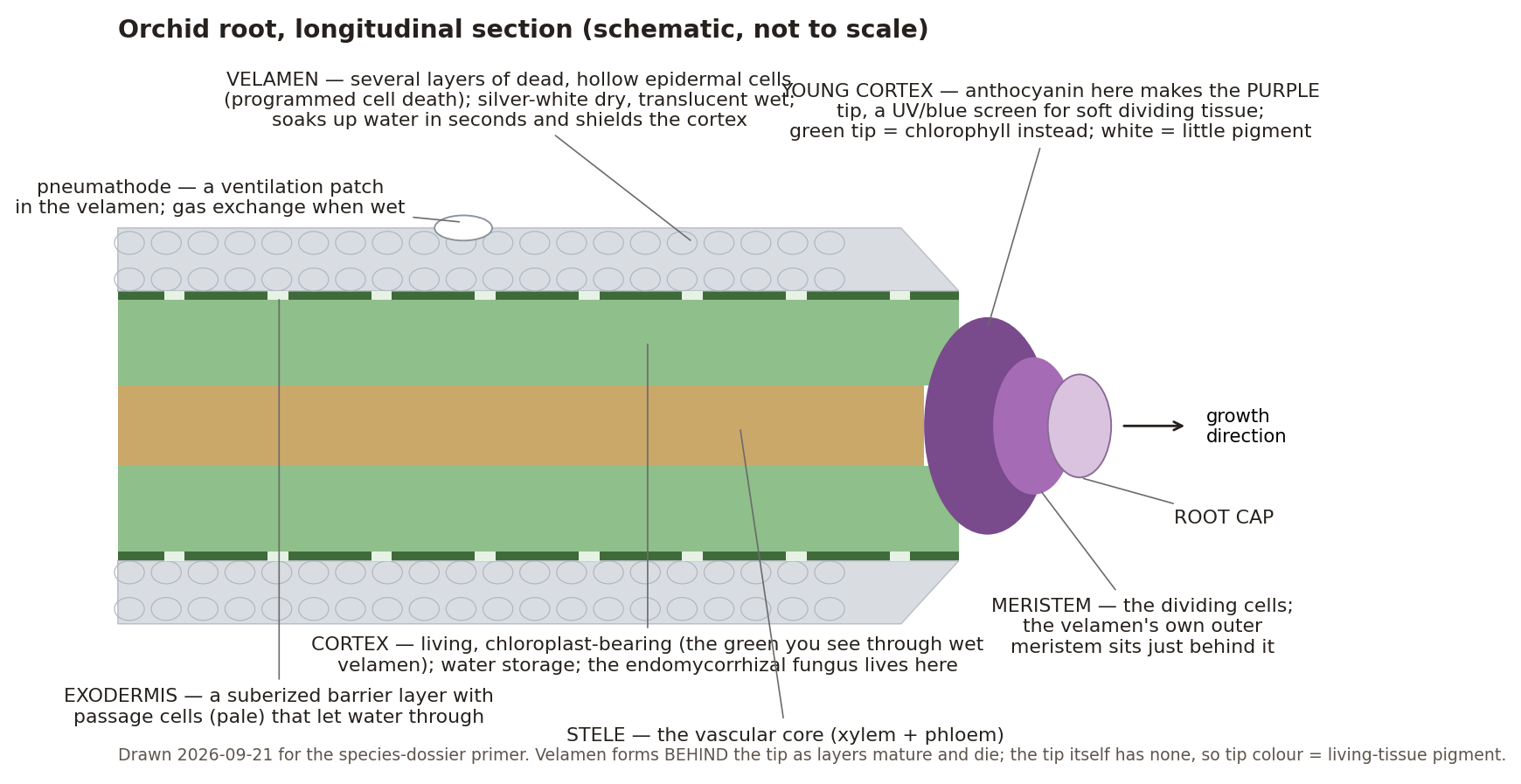 Root schematic — see the primer.
Grower’s layer (his, 2026-09-21)
Flower colour, 2026-09-21: “green yellow, no nerves viewable.” Agrees with Rolfe’s 1917 protologue (“light greenish yellow with darker nerves”); the nerves need a loupe at ~5 mm. First colour record for this plant.
“I have been to Monteverde.” Walked the cloud forest before the naturalist’s eyes: “I have general impression of walking through the cloud forest but I would have much sharper eyes these days, alas.” So the microhabitat section above is the literature’s; his own record of the phorophytes, the moss depth, and the epiphyte load is an impression, not an observation. A return would be a different walk. And: “I have been to Lankaster!!” — the Lankester Botanical Garden at Cartago, whose founder collected this plant’s holotype at Cachí, twenty minutes away.
Sources
- https://powo.science.kew.org/taxon/urn:lsid:ipni.org:names:1193873-2 — POWO record for Specklinia costaricensis (fetch blocked by Cloudflare; content confirmed through 2 and search excerpts).
- https://colplanta.org/taxon/urn:lsid:ipni.org:names:1193873-2 — Kew’s ColPlanta mirror of the POWO record: accepted name, Lindleyana citation, native range “Costa Rica to W. Ecuador”, distribution list, synonyms, epiphyte, wet tropical biome.
- https://api.gbif.org/v1/species/2835490 (and /synonyms, /iucnRedListCategory) — GBIF backbone: accepted status, publication, synonyms with citations, IUCN “Not Evaluated”.
- https://api.gbif.org/v1/occurrence/search?taxonKey=2835490&limit=300 — 236 occurrence records: countries, provinces, elevations, dates, label habitat and phenology text (downloaded 2026-09-21).
- https://www.ipni.org/n/202648-2 — IPNI record for Pleurothallis costaricensis Rolfe: Bull. Misc. Inform. Kew 1917(2): 80, published 11 Aug 1917.
- https://archive.org/details/lbg.635.05.rbg.n.17 — Bulletin of Miscellaneous Information, Kew, 1917, p. 80, “New Orchids: Decade XLV”, no. 441: the Latin protologue, type citation (Lankester 21, near Cachí), Kew flowering May 1916, flower colour.
- https://www.epidendra.com/taxones/Specklinia/Specklinia%20costaricensis/index.html — JBL Epidendra: basionym, type (Lankester 21, near Cachí, Paraíso, Cartago; holotype K), spirit/silica/DNA holdings.
- https://www.biotaxa.org/Phytotaxa/article/view/phytotaxa.272.1.1 — Karremans et al. 2016, Phytotaxa 272(1): abstract of the Specklinia reassessment (about 100 species, ten genera synonymised, five subgenera, sister group).
- https://zenodo.org/records/13659678 — Figure 1 of the 2016 paper: names of the five subgenera and neighbouring genera.
- https://pmc.ncbi.nlm.nih.gov/articles/PMC13467765/ — 2026 taxonomic review of Specklinia in Mexico (Plants): genus size, distribution, subgenera with lectotypes, flower morphology, flowering biology (1–2 week flowers, simultaneous/gregarious Hymenodanthae), fruit timing and set, pollinator families.
- https://www.orchidspecies.com/pleurcostaricensis.htm — IOSPE species page: Luer’s subsection, Cartago and Panama, 650–1,800 m, habit, inflorescence, 6–12 simultaneous flowers, 5 mm, spring–fall.
- https://www.orchidspecies.com/longicaule.htm — IOSPE page on subsection Longicaulae: diagnosis, type P. grobyi.
- https://pmc.ncbi.nlm.nih.gov/articles/PMC4549958/ — Karremans et al. 2015, Annals of Botany 116: 437–455: Drosophila pollination of the S. endotrachys complex, tiglate pheromones, sepal nectar, 8 % fruit set, no autogamy, generalisation to Pleurothallidinae.
- https://www.isleofportlandorchids.co.uk/orchid-information-pages/specklinia-costaricensis (and the /pleurothallis-costaricensis page) — grower notes: sporadic year-round flowering, 12 °C minimum, shade, slow growth.
- https://glassboxtropicals.com/pleurothallis-specklinia-costaricensis/ — grower notes: several bloomings a year, warm-to-hot, terrarium tolerance, sphagnum mount.
- https://orchidee.de/en/specklinia-costaricensis/ — grower notes: 5 cm leaves, up to 12 non-fragrant yellow flowers, spring–autumn, cooler to induce flowering, constant moisture.
- https://ecuagenera.com/products/pleurothallis-cardiothallis — Ecuagenera listing of Specklinia costaricensis (availability only).
- https://api.inaturalist.org/v1/observations?taxon_id=638303 (and /histogram with term_id=12&term_value_id=13) — iNaturalist: 66 observations, flowering annotations by month, sensitive-geoprivacy flag.
- https://www.imn.ac.cr/documents/10179/20909/Regionalización+climática+de+Costa+Rica — IMN (Solano), “Regiones y subregiones climáticas de Costa Rica”: PN3, RN1, VC1–VC3 tables (rain, temperatures, rain days, dry-period length).
- https://en.wikipedia.org/wiki/San_Jos%C3%A9,_Costa_Rica — monthly climate table for San José (1,030 m), Deutscher Wetterdienst / NOAA normals.
- https://www.weather2travel.com/costa-rica/monteverde/climate/ — Monteverde monthly averages derived from CRU / Met Office / KNMI data.
- https://blog.ocoteahotel.com/a-year-in-monteverde-what-to-expect-from-each-month — month-by-month description of Monteverde’s windy, sunny and rainy seasons.
- https://arcollab.net/wp-content/uploads/2021/06/Newcomer2022_Chapter_TheMonteverdeCloudForest.pdf — Newcomer et al. 2022, “The Monteverde Cloud Forest”: seven life zones, 466–1,850 m, trade winds Dec–Mar, dry-day trend (Pounds et al. 2006), Jan–Apr rainless days.
- https://en.wikipedia.org/wiki/Monteverde — 1,400 m, 18 °C mean, ~3,000 mm, humidity 74–97 % (citing Nadkarni).
- https://cloudforestmonteverde.com/the-cloud-forest/ — reserve page: 1,200–2,500 m, up to 3,000 mm, mist ~40 % of water input, 14–22 °C.
- https://en.wikipedia.org/wiki/Alberto_Manuel_Brenes_Biological_Reserve — San Ramón reserve life zones (premontane rain forest >80 %, lower montane rain forest ~10 %).
- https://en.wikipedia.org/wiki/Orchidaceae — CITES statement: almost all orchids in Appendix II, some genera in Appendix I.
- https://cites.org/eng/app/appendices.php — CITES Appendices (fetch blocked; flasked-seedling and seed/pollen exemptions cited from search excerpts of CITES pages).
- https://www.visitcostarica.com/planning-your-trip/climate and https://bluegreenatlas.com/climate/costa_rica_climate.html — Pacific vs Caribbean regimes, veranillo.
- https://panamabiota.org/stri/taxa/index.php?taxauthid=1&taxon=112561&clid=61 — STRI Panama flora portal: species present in the Panama checklist, synonyms.
- https://en.wikipedia.org/wiki/Specklinia — 109 accepted species in POWO as of 2025; species list includes S. costaricensis.
- https://api.gbif.org/v1/species/search?q=Pleurothallis%20costaricensis — the later homonym Pleurothallis costaricensis Schltr. (1918) = P. cardiothallis.
Unverified / gaps
- Which of Karremans’ five subgenera formally contains S. costaricensis: inferred to be subgen. Hymenodanthae from the shared lectotype with Luer’s subsection; the 2016 species lists (Phytotaxa full text) were not accessible.
- The Manual de Plantas de Costa Rica vol. 3 (Orchidaceae, 2003) treatment and Pupulin’s 2002 catalogue entry were not reached; Tropicos pages require a browser. Their elevation, habitat and flowering-month statements would be the best single Costa Rican summary.
- Luer’s full species description in Icones Pleurothallidinarum (Systematics of Specklinia, 2006) was not accessible; the dorsal-sepal apex character (thickened vs calyptrate) is unknown for this species.
- No pollination, scent-chemistry, breeding-system or capsule data exist for this species; all reproductive biology above is genus-level.
- No published flower longevity, opening order, or ramicaul-initiation timing for this species.
- No in-situ light (PPFD) or microclimate measurements for the plant’s actual perch.
- Colombian and Peruvian records may belong to look-alikes in the S. grobyi complex; not checked against modern determinations. Nicaragua: no record found.
- The protologue’s “bracteae circiter 15 mm longae” is an OCR reading and is probably 1.5 mm; not checked against the scanned page image.
- Rolfe’s 9 mm sepals vs IOSPE’s 5 mm flower size are unreconciled.
- Monteverde monthly figures are gridded (CRU) rather than a named station; the Monteverde Institute or Tropical Science Center station normals (in Nadkarni & Wheelwright 2000, Clark et al. chapter) would be better but were not reachable.
- POWO, Tropicos, CITES, climate-data.org and MDPI pages were all blocked to automated fetch; each is cited through a mirror, an API, or a secondary transcription and marked accordingly.