📖 Species-dossier vocabulary primer
What this is: the working vocabulary of the three in-situ dossiers (Capanemia micromera — in situ dossier · Hoya carnosa — in situ dossier · Pleurothallis costaricensis — in situ dossier), built 2026-09-21 at his request (“create a primer of vocab from these reports to learn somehow”). Nine groups, ordered as a lesson: names → data → place → climate → life form → body → flower → tree of life → status. Each entry = one-line meaning · the system it belongs to · the discriminator from its nearest neighbour. The lesson walk-through and the flashcard page ride on this note; this note is the record.
1. Names and who decides them
- Accepted name — the name a taxonomic authority currently treats as correct · Kew WCVP/POWO editorial opinion under the ICN · vs. a synonym, a valid name now filed under another.
- Synonym — a published name judged to refer to the same taxon · WCVP/GBIF backbone · heterotypic (different type specimen) vs. homotypic (same type, renamed).
- Basionym — the original name a later combination is built on (Asclepias carnosa → Hoya carnosa; Pleurothallis costaricensis → Specklinia costaricensis) · ICN · the basionym’s author stays in parentheses.
- Authority — the author(s) after a name, e.g. Barb.Rodr., (L.f.) R.Br. · IPNI standard abbreviations · parentheses = basionym author; the name after = who made the combination.
- Protologue — everything published with a name at its birth: description, diagnosis, type citation · ICN · the protologue is the evidence; the description is only part of it.
- Holotype — the single specimen the name is permanently attached to (Lankester 21 at Kew) · ICN · vs. isotype (a duplicate) and lectotype (chosen later).
- Type species — the species a genus name is anchored to (C. micromera for Capanemia) · ICN · the genus can shrink to one species and it will be this one.
- Homonym — the same name published twice for different plants (Pleurothallis costaricensis Rolfe 1917 vs. Schltr. 1918) · ICN · the later one is illegitimate; nurseries cite them interchangeably.
- IPNI — International Plant Names Index: every validly published vascular-plant name with author, place, date; no opinion on correctness · Kew + Harvard + Canberra.
- WCVP — World Checklist of Vascular Plants: Kew’s accepted/synonym decisions and distributions · Kew editors · the opinion layer over IPNI.
- POWO — Plants of the World Online: the public portal joining IPNI + WCVP + images + descriptions · Kew · “accepted per POWO” = WCVP’s view.
- Tropicos — Missouri Botanical Garden’s names-and-specimens database, strong for the Neotropics · vs. POWO: a second, independent opinion.
- GBIF — Global Biodiversity Information Facility: an intergovernmental aggregator of occurrence records with an open API · Copenhagen · an index of records, not an authority on names (it borrows a backbone).
- Occurrence record — one organism, one place, one time, one basis · Darwin Core · basis of record: preserved specimen (herbarium) vs. human observation (iNaturalist) — the triangles and dots on the maps.
- Georeferenced — carries latitude/longitude · GBIF flag · “no geospatial issue” = passed automated sanity checks, not verified.
- Herbarium specimen — a pressed, labelled, permanently stored plant; the label is primary data · vs. an observation, which is a photograph and a claim.
2. Where it lives
- Biome / domain — a broad vegetation region; in Brazil the six IBGE biomes (Atlantic Forest, Cerrado, Pampa…) · IBGE, and the 2006 Atlantic Forest law · legal category, not a climate.
- Atlantic Forest (Mata Atlântica) — the coastal-and-plateau forest biome from Rio Grande do Norte to Rio Grande do Sul · IBGE · its “subtropical” third = south of the Tropic of Capricorn, a climatic qualifier.
- Ombrophilous forest /ɒmˈbrɒfɪləs/ (om-BROF-ih-lus) — “rain-loving”: evergreen, high rainfall, no dry season · IBGE Floresta Ombrófila · Densa (broadleaf) vs. Mista (with Araucaria).
- Araucaria forest — Floresta Ombrófila Mista, the cool foggy plateau forest with Araucaria angustifolia emergent · IBGE · ~3 % of original extent survives.
- Seasonal semideciduous forest — 20–50 % of canopy trees drop leaves in the dry/cold season · IBGE Floresta Estacional Semidecidual · vs. deciduous (> 50 %) and ombrophilous (evergreen).
- Riparian / gallery forest — the strip along a watercourse; humid through dry months, bright at the edge · mata ciliar · gallery = the same strip where it is the only forest in grassland.
- Secondary forest — regrowth after clearing or logging · land-cover class on labels · vs. primary (never cleared) and degraded primary (thinned).
- Cloud forest — montane forest immersed in cloud much of the year; mist supplies a large share of its water (~40 % at Monteverde) · Holdridge “lower montane rain forest” in Costa Rica · vs. rain forest, which gets its water as rain.
- Montane / premontane — elevation belts (premontane ≈ 500–1,500 m, lower montane ≈ 1,500–2,500 m in Costa Rica) · Holdridge life zones · defined by temperature, not by a fixed altitude.
- Holdridge life zone — a climate-vegetation cell defined by biotemperature, rainfall, and evapotranspiration · Holdridge 1947/1967 · the standard system in Central America, as IBGE is in Brazil.
- Yungas — the humid montane forests on the eastern Andean slopes of Bolivia and NW Argentina · regional term · the Capanemia disjunct lobe.
- Disjunct — a population separated from the main range by a gap it cannot cross · biogeography · raises the question of relict vs. long-distance dispersal.
- Karst / limestone forest — forest on dissolved limestone, thin soils, dry rock faces (the Ryukyu Hoya sites) · geomorphology · favours lithophytes and CAM plants.
- Ryukyus — the island arc from Kyushu to Taiwan (Amami, Okinawa, Ishigaki) · Japan · Hoya’s northern limit.
3. Climate words
- Köppen Cfa / Cfb — humid subtropical (hot summer) / oceanic (warm summer); the “f” = no dry season · Köppen–Geiger · Curitiba is Cfb, Porto Alegre Cfa.
- Climate normals — 30-year monthly averages from a named station (INMET 1991–2020; IMN in Costa Rica) · WMO convention · vs. a single year’s record.
- Dry season — months with rainfall well below evapotranspiration · climatology · “no dry season” is why no rest is warranted for these plants.
- Trade winds — the steady NE winds that carry Caribbean cloud over the Tilarán crest through the Pacific “dry” months · meteorology · the reason Monteverde stays wet in February.
- Cloud immersion / mist — water delivered as fog droplets, not rain · cloud-forest hydrology · what a terrarium mister imitates.
- Relative humidity (RH) — water vapour as a % of saturation at that temperature · the box’s Inkbird reads this; VPD (vapour-pressure deficit) is the plant’s-eye version.
- Diurnal swing — day–night temperature difference (~10 °C on the Araucaria plateau) · the biggest gap between the box and the wild.
4. Life form
- Epiphyte — a plant growing on another plant for support only, not parasitic · Benzing’s life-form classes · vs. parasite (takes nutrients) and vine (rooted in soil).
- Holoepiphyte /ˌhɒloʊˈɛpɪfaɪt/ (HOL-oh-EP-ih-fite) — spends its whole life cycle on the host, never in soil · vs. hemiepiphyte (starts or ends in soil, e.g. strangler figs) and accidental epiphyte.
- Lithophyte — grows on rock · Hoya can; Capanemia never recorded.
- Phorophyte /ˈfɒrəˌfaɪt/ (FOR-uh-fite) — the host tree an epiphyte sits on · epiphyte ecology · named on good labels (Endlicheria, Eugenia, Ilex paraguariensis).
- Twig epiphyte (obligate) — found predominantly on ultimate branchlets < 2 years old · Chase 1987; Gravendeel et al. 2004 · a syndrome: tiny body, early flowering, short life, clasping roots, high-light tolerance → mount on a thin twig, roots in air.
- CAM (Crassulacean acid metabolism) — stomata open at night to take in CO₂, fix it by day behind closed stomata; the water-saving photosynthesis of succulents and many epiphytes · plant physiology · Hoya is CAM; “CAM-idling” = stomata shut for weeks, metabolism ticking over.
- Stomata — the leaf pores that trade CO₂ for water loss · when they open (day vs. night) is the C3/CAM distinction.
- Succulence — water storage in thick leaves or stems · Hoya leaves; orchid pseudobulbs do the same job differently.
- Velamen /vəˈleɪmən/ (vuh-LAY-mun) — the spongy dead-cell sheath on orchid roots that soaks up water and protects the living core · orchid anatomy · multiseriate = several cell layers thick (Capanemia).
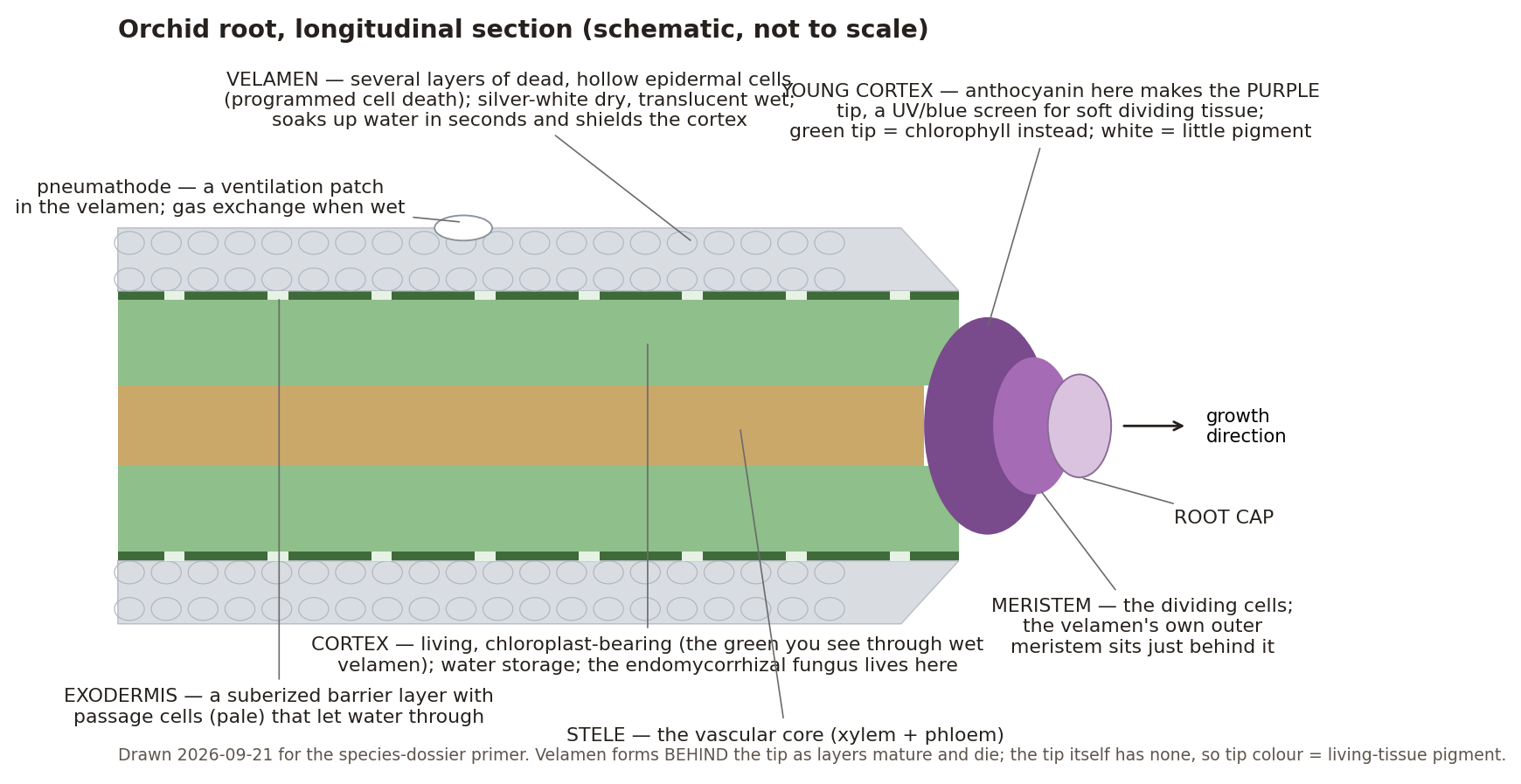 Orchid root, longitudinal section (schematic). The velamen forms behind the tip as epidermal layers mature and die by programmed cell death; the tip itself has none, so its colour is living-tissue pigment. Drawn 2026-09-21.
- Mycorrhiza (endo-) — fungus living inside the root cortex, feeding the plant; obligatory for orchid germination · symbiosis · endo- (inside cells) vs. ecto- (sheathing).
5. Body plan
- Pseudobulb /ˈsuːdoʊˌbʌlb/ (SOO-doh-bulb) — a swollen stem segment that stores water (3–4 × 6–10 mm in Capanemia) · orchid morphology · not a true bulb (no fleshy leaf bases).
- Rhizome /ˈraɪzoʊm/ (RY-zohm) — the horizontal stem that links growths · a “very short rhizome” makes a mat; a long one makes a rambler (Bulbophyllum alagense).
- Caespitose /ˈsɛspɪˌtoʊs/ (SESS-pih-tohss) — tufted, growths packed from a compact base, no creeping rhizome (Specklinia) · vs. repent/creeping.
- Ramicaul /ˈræmɪˌkɔːl/ (RAM-ih-kawl) — the slender stem of a pleurothallid bearing one leaf; the genus’s version of a pseudobulb · Pleurothallidinae term (Luer).
- Terete / subterete / acicular /təˈriːt/ (tuh-REET) · /ˌsʌbtəˈriːt/ · /əˈsɪkjʊlər/ (uh-SIK-yoo-lur) — cylindrical / nearly so / needle-like (Capanemia’s leaf) · vs. flat (Pabst’s rejected section Planifolia).
- Coriaceous /ˌkɔːriˈeɪʃəs/ (kor-ee-AY-shus) — leathery (the Specklinia leaf) · vs. membranous, succulent.
- Raphide / idioblast /ˈræfaɪd/ (RAF-ide) · /ˈɪdioʊˌblæst/ (ID-ee-oh-blast) — needle crystals of calcium oxalate / the specialised cell that holds them · anatomy · herbivore defence, seen in Capanemia leaf sections.
6. Flowers and what they do
- Raceme — flowers on stalks along an elongating axis, oldest at the base (Specklinia, Capanemia) · vs. umbel, all stalks from one point (Hoya’s ball).
- Peduncle / pedicel / bract — the inflorescence stalk / each flower’s stalk / the small leaf at a flower’s base · Hoya’s perennial peduncle (the spur) reblooms for years.
- Sepal / petal / lip (labellum) — outer whorl / inner whorl / the modified median petal that is the orchid’s landing platform · synsepal /ˈsɪnˌsɛpəl/ (SIN-sep-ul) = the two lateral sepals fused (Specklinia).
- Callus — the raised, often coloured pad on the lip (Capanemia’s yellow callus) · a visual nectar guide on a flower with no nectar.
- Column — the orchid’s fused stamen-and-style organ · what makes an orchid an orchid.
- Corolla / corona — the petal whorl / the extra ring of appendages above it (Hoya’s inner star) · Apocynaceae · the corona’s colour is the Hoya ID decider.
- Pollinarium / pollinia / viscidium /ˌpɒlɪˈnɛəriəm/ (pol-ih-NAIR-ee-um) · /pəˈlɪniə/ (puh-LIN-ee-uh) · /vɪˈsɪdiəm/ (vih-SID-ee-um) — the whole detachable pollen package / its waxy pollen masses / the sticky pad that glues it to a visitor · orchids and asclepiads both · “pollinaria removed, not deposited” = visited, not pollinated.
- Stigma / anther — the receptive surface / the pollen organ · deposition on the stigma is the proof of pollination.
- Osmophore /ˈɒzməˌfɔːr/ (OZ-muh-for) — a scent-producing gland · Capanemia’s lip papillae were judged not to be these.
- Nectar / reward / food deception — the sugar bribe / any reward / a flower that mimics a rewarding one and offers nothing (two Capanemia species, Pansarin 2021) · pollination biology · Hoya is the opposite: copious midnight nectar.
- Self-incompatibility / autogamy — genetic rejection of own pollen / self-pollination without a visitor · Oncidiinae are 69 % self-incompatible; Specklinia endotrachys group shows no autogamy.
- Capsule / follicle — the orchid’s dry dehiscent fruit / the asclepiad’s pod that splits down one side (Hoya) · fruit type is a family-level tell.
- Anthesis /ænˈθiːsɪs/ (an-THEE-sis) — the period a flower is open and functional · flower longevity = anthesis length (1–2 weeks in Specklinia).
- Circadian / entrainment / photoperiod — an internal ~24 h clock / resetting it by an external cue / day-length as that cue · Hoya’s scent and nectar peak at night on a ~29 h free-running clock.
- Phenology — the timing of recurring life events (flowering, fruiting, growth) against the seasons · ecology; in the dossiers, a data category read from specimen months · when, not how.
7. The tree of life
- Subfamily / tribe / subtribe — ranks between family and genus (Orchidaceae › Epidendroideae › Cymbidieae › Oncidiinae; › Epidendreae › Pleurothallidinae) · ICN ranks · the subtribe is where care traits cluster.
- Asclepiadoideae — the milkweed subfamily of Apocynaceae, Hoya’s home · pollinaria evolved here independently of orchids.
- Clade — an ancestor and all its descendants · monophyletic = a clade; a genus that isn’t is a target for revision.
- Sister — the closest relative on the tree (Sanderella to Capanemia) · a statement about branching, not similarity.
- ITS — the nuclear ribosomal internal transcribed spacer, the workhorse DNA region for plant phylogenies · molecular systematics · fast-evolving, good within genera, occasionally misleading (a Hoya carnosa clone grouping with pubicalyx).
- Support (low / high) — how often a branch recurs when the analysis is re-run (bootstrap) or its posterior probability · low support = keep the hypothesis, don’t lean on it.
8. Status and trade
- IUCN Red List categories — Least Concern (LC) · Near Threatened · Vulnerable · Endangered · Critically Endangered · Not Evaluated (NE) = never assessed, not “safe” · IUCN · national lists (CNCFlora Brazil) use the same categories independently.
- EOO / AOO — extent of occurrence (the polygon around all records) / area of occupancy (the 2 × 2 km cells actually occupied) · IUCN criterion B · a species can have a huge EOO and a tiny AOO.
- CITES Appendix II — trade regulated by permit, not banned; all orchids are listed at the family level · CITES · vs. Appendix I (trade banned).
- Endemic — found only in a defined area · biogeography · Kalm’s St John’s wort is a Great Lakes endemic; none of the three dossier plants is a single-country endemic.
9. Cultivation words
- Cultivar — a cultivated variety with a name in single quotes (‘Krimson Queen’) · ICNCP, the cultivated-plant code · not a botanical rank.
- Sport — a spontaneous mutant shoot propagated into a cultivar (‘Compacta’, Hummel 1967) · vs. a seedling selection.
- Variegation / chimera — patterned loss of chlorophyll / a plant of two genetically different cell layers, which is how most stable variegation exists · horticulture · the leaf sports carry the species’ flowers unchanged.
Related
Horticulture - Working Conventions § Species-dossier protocol · Horticulture - Orchid Terrarium Inspection · Horticulture - Houseplants